DOFPro Team

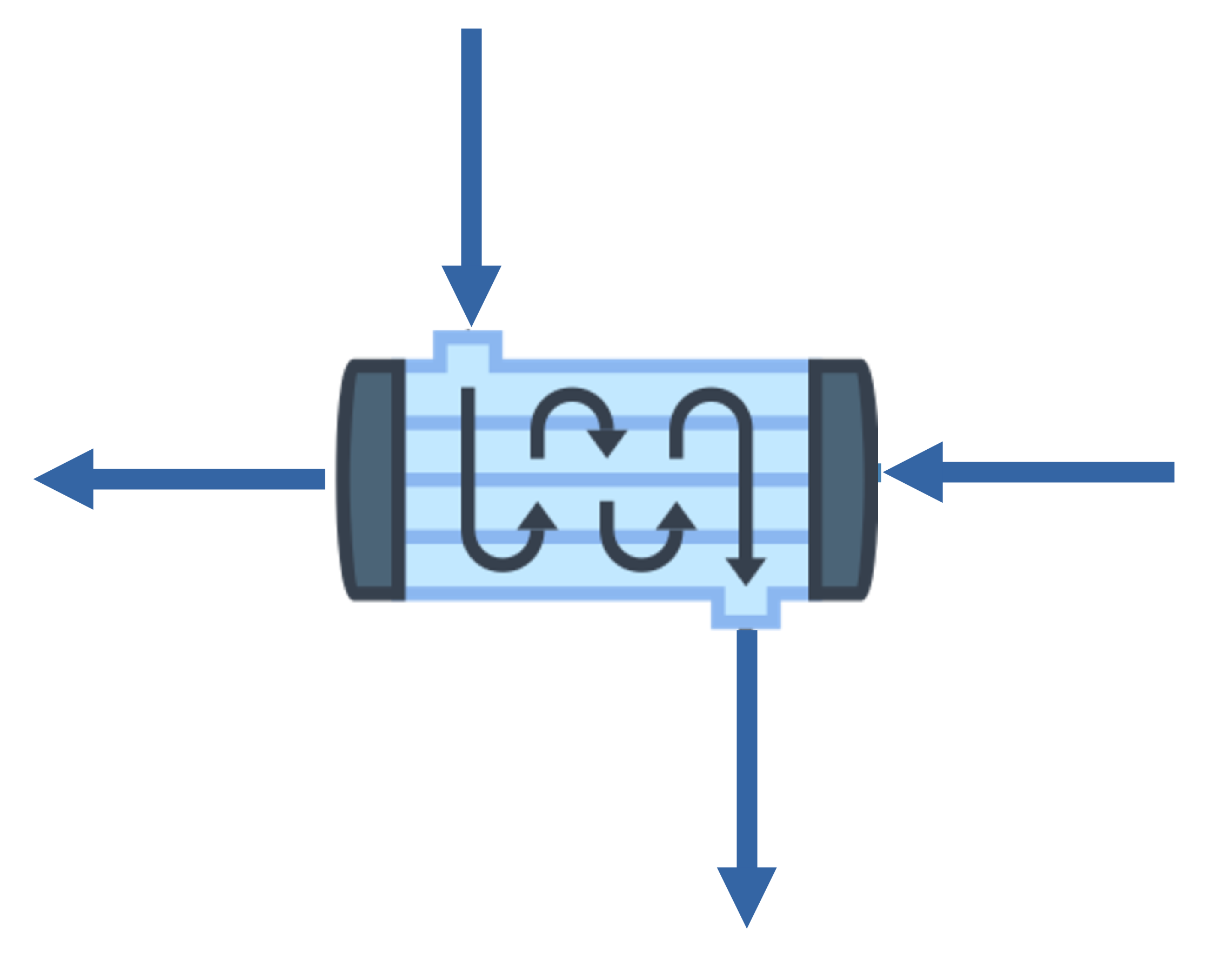
Cool 100 mol/s of ethanol from 100°C to 50°C
What is the minimum work required or maximum work obtainable?

\(\dot{m}\Delta H = \dot{Q} + \dot{W}_s = 0\)
\(\dot{Q} = 0\)
\(\boxed{\dot{W}_s = 0}\)
\(\mathrm{EtOH}\)
\(100\ ^\circ\mathrm{C}\)
\(90\ ^\circ\mathrm{C}\)
\(50\ ^\circ\mathrm{C}\)
\(40\ ^\circ\mathrm{C}\)
\(\mathrm{H_2O}\)

\(\boxed{\dot{W}_s\text{ into system (Oops)}}\)
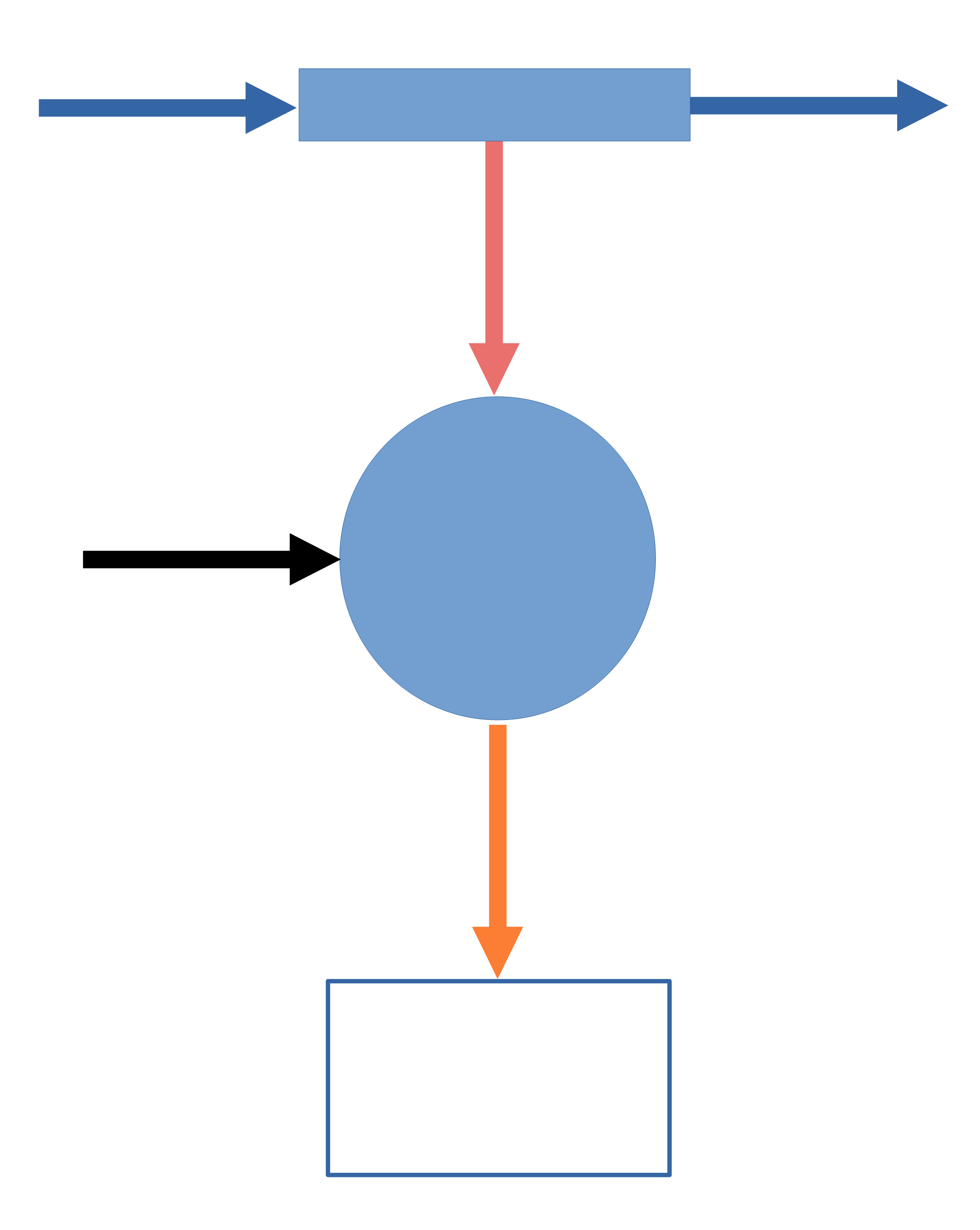
\(\mathrm{EtOH}\)
\(100\ ^\circ\mathrm{C}\)
\(50\ ^\circ\mathrm{C}\)
\(|\dot{Q}_\mathrm{cold}|\)
\(|\dot{Q}_\sigma|\)
\(|\dot{W}_s|\)
Ambient, \(T_\sigma\)

\(\dot{W}_\text{total} = \dot{m}(\hat{Q} - T_\sigma \Delta \hat{S})\)
\[= \dot{m} \left(\int_{100}^{50} C_p dT - T_\sigma \int_{100}^{50} \dfrac{C_p}{T} dT\right)\]
\(= 100[-6722.36 - 300(-19.2917)]\)
\(= -93.49 \text{ kJ/s} = W_\text{max}\)
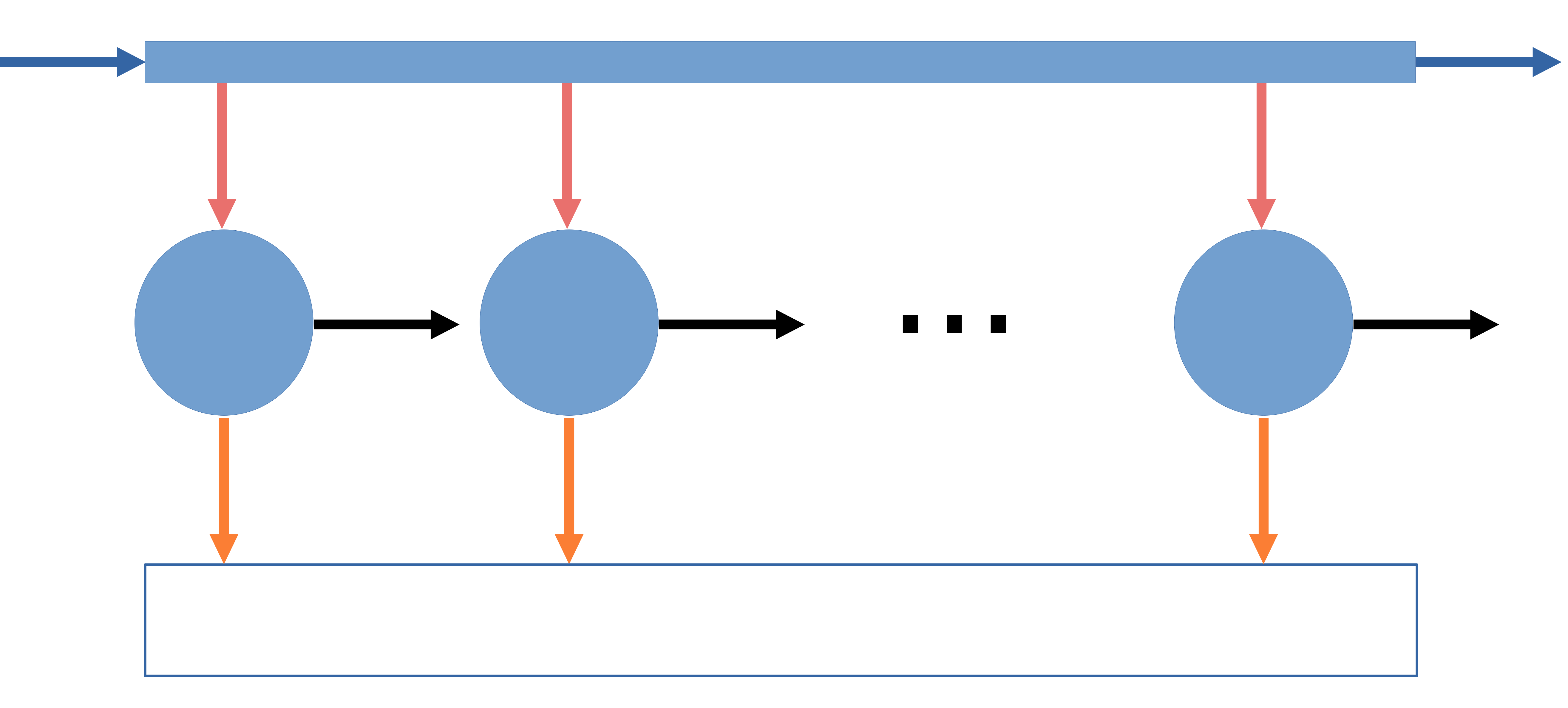
\(\mathrm{EtOH}\)
\(100\ ^\circ\mathrm{C}\)
\(50\ ^\circ\mathrm{C}\)
\(|\delta\dot{Q}_\mathrm{hot}|\)
\(|\delta\dot{Q}_\sigma|\)
\(|\delta\dot{W}_s|\)
Ambient, \(T_\sigma\)
For an open transient system, the First Law is
\(\dfrac{d}{dt}(U + E_k + E_p)_{\text{control volume}} = \sum \dot{Q}_i + \sum \dot{W}_{s_j} - (\Delta \dot{H} + \Delta \dot{E}_k + \Delta \dot{E}_p)_{\text{flow streams}}\)
which on a mass basis is
\(\dfrac{d}{dt}\left[m\left(\hat{U} + \hat{E}_k + \hat{E}_p\right)\right]_\mathrm{cv} = \sum \dot{Q}_i + \sum \dot{W}_{s_i} + \sum\limits_\mathrm{in} \dot{m}_i\left(\hat{H} + \hat{E}_k + \hat{E}_p\right) - \sum\limits_\mathrm{out} \dot{m}_i\left(\hat{H} + \hat{E}_k + \hat{E}_p\right)\)
or on a mole basis is
\(\dfrac{d}{dt}\left[n\left(\hat{U} + \hat{E}_k + \hat{E}_p\right)\right]_\mathrm{cv} = \sum \dot{Q}_i + \sum \dot{W}_{s_i} + \sum\limits_\mathrm{in} \dot{n}_i\left(\hat{H} + \hat{E}_k + \hat{E}_p\right) - \sum\limits_\mathrm{out} \dot{n}_i\left(\hat{H} + \hat{E}_k + \hat{E}_p\right)\)
For an open transient system, the Second Law is
\(\dfrac{dS_\mathrm{cv}}{dt} + \Delta ( \dot{S} )_\mathrm{fs} - \sum_j \dfrac{\dot{Q}_j}{T_j} = \dot{S}_G \geq 0\)
\(\dfrac{d ( m\hat{S} )_\mathrm{cv}}{dt} + \Delta ( \dot{m}\hat{S} )_\mathrm{fs} - \sum_j \dfrac{\dot{Q}_j}{T_j} = \dot{S}_G \geq 0 \quad\) Mass Basis
or \(\dfrac{d ( n\hat{S} )_\mathrm{cv}}{dt} + \Delta ( \dot{n}\hat{S} )_\mathrm{fs} - \sum_j \dfrac{\dot{Q}_j}{T_j} = \dot{S}_G \geq 0 \quad\) Mole Basis
\(\dot{Q}_j\) is heat transferred into system from reservoir \(j\)
\(T_j\) is temperature of reservoir \(j\)
Combine (add the two equations) and solve for \(\sum \dot{W}_{s_i} = \dot{W}_s\)
Ambient \(T\) is \(T_\sigma\).
\(\dot{W}_s = \frac{d}{dt} \left( U + E_k + E_p - T_\sigma S \right)_\mathrm{cv} - \sum \left( 1 - \frac{T_\sigma}{T_i} \right) \dot{Q}_i + \left( \Delta \dot{H} + \Delta \dot{E}_k + \Delta \dot{E}_p - T_\sigma \Delta \dot{S} \right)_\mathrm{fs} + T_\sigma \dot{S}_\mathrm{gen}\)
\(\dot{Q}_\sigma\) is transfer to ambient at \(T_\sigma\) and doesn’t show up in the balance.
What is \(T_\sigma \dot{S}_\mathrm{gen}\)? \(\quad\) \(T_\sigma \dot{S}_\mathrm{gen} = \dot{W}_\mathrm{lost}\)
If \(\dot{S}_\mathrm{gen} = 0 \Rightarrow \dot{W}_\mathrm{lost} = 0\), then \(\quad \dot{W}_{s} = \dot{W}_\mathrm{ideal}\)
\(\dot{W}_\mathrm{ideal}\) is the ideal work or the reversible work. It (or the negative of it) is sometimes called availability, available work or exergy.
Open Transient System
\(\dot{W}_{\text{ideal}} = \dfrac{d}{dt}(U + E_k + E_p - T_\sigma S)_\mathrm{cv} - \sum \left(1 - \dfrac{T_\sigma}{T_i}\right) \dot{Q}_i + (\Delta \dot{H} + \Delta \dot{E}_k + \Delta \dot{E}_p - T_\sigma \Delta \dot{S})_\mathrm{fs}\)
On a mass basis
\(\dot{W}_{\text{ideal}} = \dfrac{d}{dt}\left[m(\hat{U} + \hat{E}_k + \hat{E}_p - T_\sigma \hat{S})\right]_\mathrm{cv} - \sum \left(1 - \dfrac{T_\sigma}{T_i}\right) \dot{Q}_i\)
\[ + \sum_{\text{out}} \dot{m}_i (\hat{H} + \hat{E}_k + \hat{E}_p - T_\sigma \hat{S}) - \sum_{\text{in}} \dot{m}_i (\hat{H} + \hat{E}_k + \hat{E}_p - T_\sigma \hat{S}) \]
Or the same equation on a mole basis with \(n\) and \(\dot{n}\) replacing \(m\) and \(\dot{m}\)
The Combined 1st and 2nd Law (cont.)
Open Steady-State System
\(\dot{W}_{\text{ideal}} = - \sum \left(1 - \dfrac{T_\sigma}{T_i}\right) \dot{Q}_i + (\Delta \dot{H} + \Delta \dot{E}_k + \Delta \dot{E}_p - T_\sigma \Delta \dot{S})_\mathrm{fs}\)
On a mass basis
\(\dot{W}_{\text{ideal}} = - \sum \left(1 - \dfrac{T_\sigma}{T_i}\right) \dot{Q}_i + \sum\limits_{\text{out}} \dot{m}_i (\hat{H} + \hat{E}_k + \hat{E}_p - T_\sigma \hat{S}) - \sum\limits_{\text{in}} \dot{m}_i (\hat{H} + \hat{E}_k + \hat{E}_p - T_\sigma \hat{S})\)
On a mole basis
\(\dot{W}_{\text{ideal}} = - \sum \left(1 - \dfrac{T_\sigma}{T_i}\right) \dot{Q}_i + \sum\limits_{\text{out}} \dot{n}_i (\hat{H} + \hat{E}_k + \hat{E}_p - T_\sigma \hat{S}) - \sum\limits_{\text{in}} \dot{n}_i (\hat{H} + \hat{E}_k + \hat{E}_p - T_\sigma \hat{S})\)
The Combined 1st and 2nd Law (cont.)
Closed System
\(W_{\text{ideal}} = \Delta U + \Delta E_k + \Delta E_p - T_\sigma \Delta S - \sum \left(1 - \dfrac{T_\sigma}{T_i}\right) Q_i\)
We will rarely encounter closed systems in thermodynamic or 2nd Law analyses.
Thermodynamic efficiency, \(\eta_t\) or \(\eta_{\tiny \mathrm{II}}\)
For processes that produce work:
\(\eta_t = \frac{\dot{W}_{s}}{\dot{W}_\mathrm{ideal}}\)
For processes that require work:
\(\eta_t = \frac{\dot{W}_\mathrm{ideal}}{\dot{W}_{s}}\)
Also the lost work or irreversibility is
\[\dot{W}_\mathrm{lost} = \dot{W}_{s} - \dot{W}_\mathrm{ideal}\]
Is \(\dot{W}_\mathrm{lost}\) always positive?
\[\dot{W}_\mathrm{lost} = T_\sigma \dot{S}_\mathrm{gen}\]
You should also analyze individual parts of a process and calculate lost work to see where the greatest inefficiencies lie.
Thanks for watching!
The previous video in the series is in the link in the upper left. The next video in the series is in the upper right. To learn more about Chemical and Thermal Processes, visit the website linked in the description.
The DOFPro Team