Gotta Keep ’Em Separated
Just the Facts
DOFPro Team

Mixer
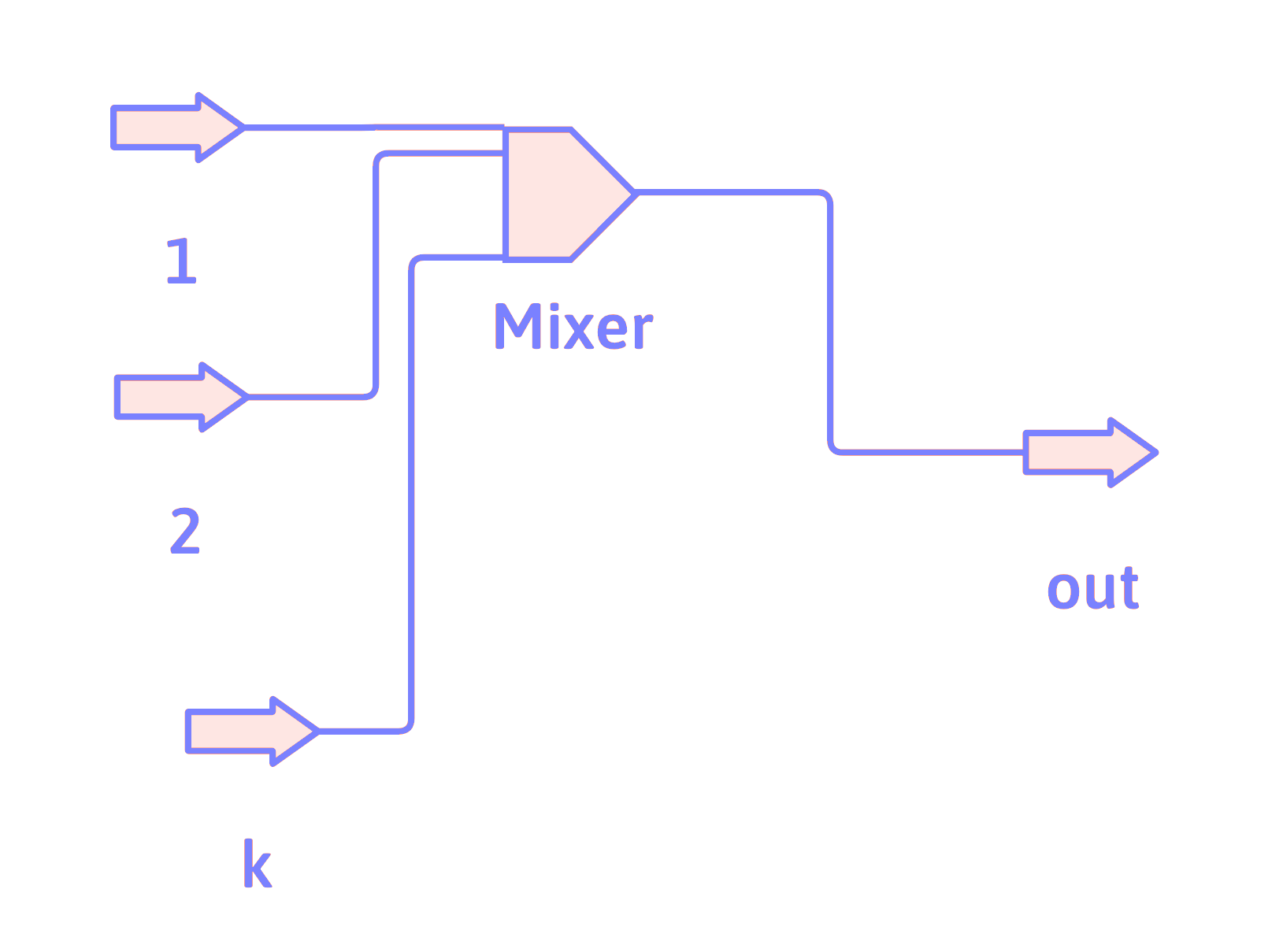
For each component, \(i\),
\[ \dot{n}_{i_\mathrm{out}} = \dot{n}_{i_1} + \dot{n}_{i_2} + \cdots +\dot{n}_{i_k} \]
Overall
\[ \dot{n}_\mathrm{out} = \dot{n}_1 + \dot{n}_2 + \cdots +\dot{n}_k \]
where
\[ \dot{n} = \sum_\mathrm{All} \dot{n}_i \]
Divider
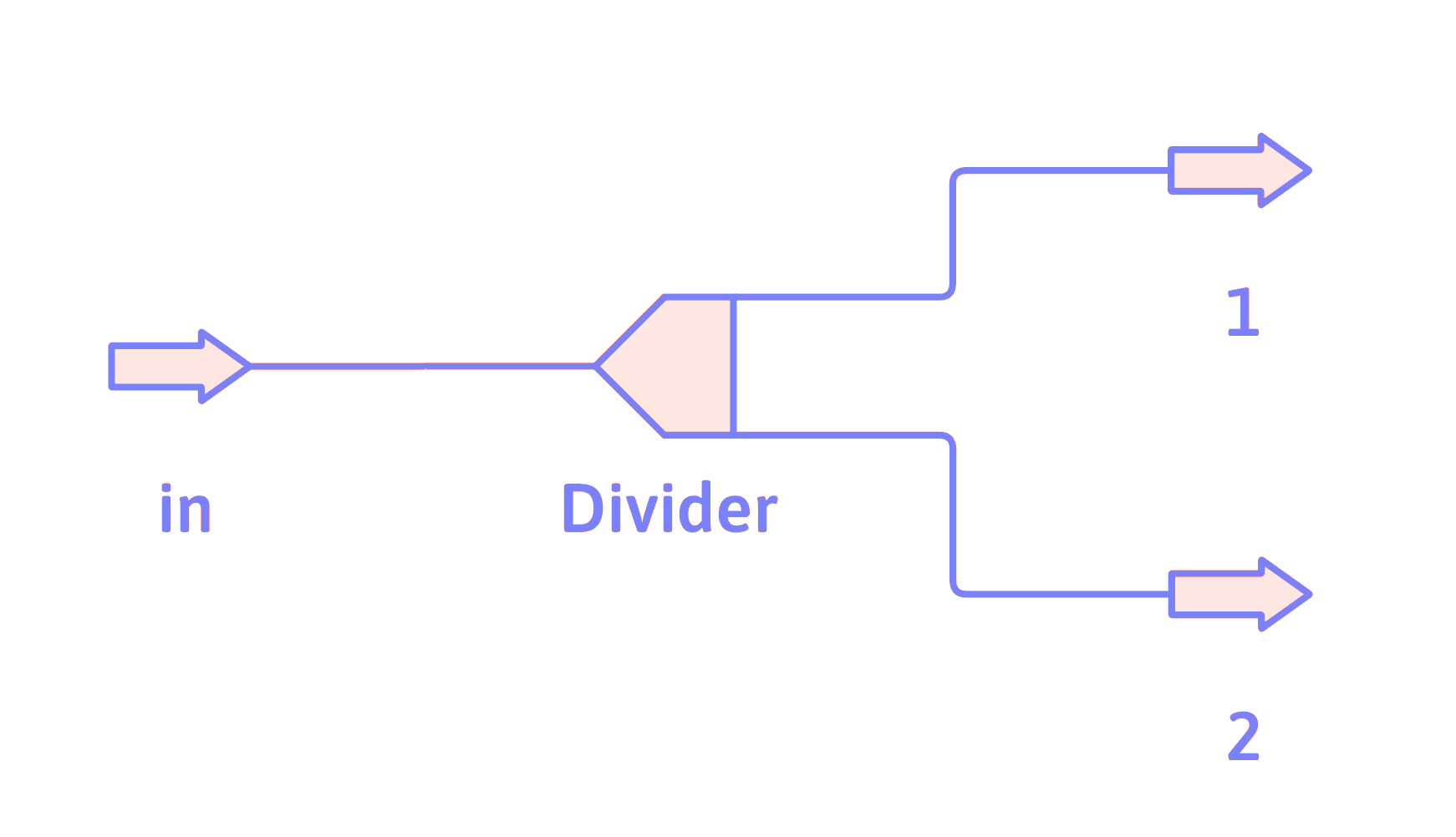
For each component, \(i\),
\[ \dot{n}_{i_\mathrm{in}} = \dot{n}_{i_1} + \dot{n}_{i_2} \]
Overall
\[ \dot{n}_\mathrm{in} = \dot{n}_1 + \dot{n}_2 \]
where
\[ \dot{n} = \sum_\mathrm{All} \dot{n}_i \]
Also
\[ x_{i_1} = x_{i_2} = x_{i_\mathrm{in}} \]
where the mole fraction, \(x_i \equiv \frac{n_i}{n_\mathrm{Total}} = \frac{\dot{n}_i}{\dot{n}}\) .
Separator
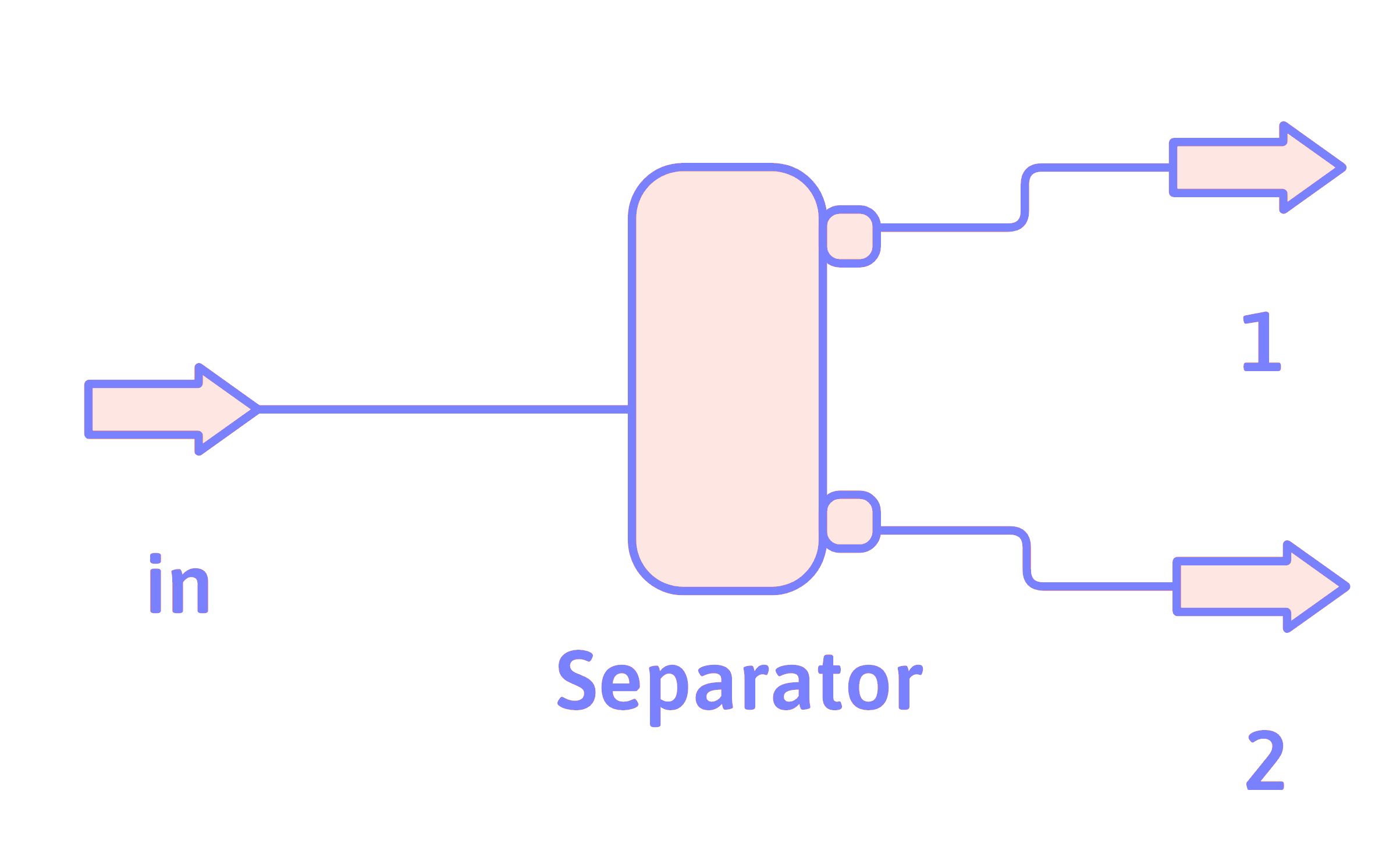
You often specify the split fraction,
\[ t_{is} \equiv \frac{\dot{n}_{i_s}}{\dot{n}_{i_\mathrm{in}}} \]
\(t_{i1}\) is the split fraction of species \(i\) with respect to Stream 1.
\[ \dot{n}_{i_1} = t_{i1} \dot{n}_{i_\mathrm{in}} \]
\[ \dot{n}_{i_2} = (1-t_{i1}) \dot{n}_{i_\mathrm{in}} \]
If the split fraction is the same for all species, then the separator is just a divider. The split fractions must be different for the different species to effect a separation.
Thanks for watching!
The Full Story companion video is in the link in the upper left. The next video in the series, When You Saw It, What Was the Extent of Your Reaction? Part 1, is in the upper right. To learn more about Chemical and Thermal Processes, visit the website linked in the description.