When You Saw It, What Was
the Extent of Your Reaction? Part 1
Just the Facts

DOFPro Team
When You Saw It, What Was
The Extent of Your Reaction?
Parts 1, 2, and 3

  • Address chemical reactors as modeled with extent of reaction and fractional conversion.
  • Moles are not conserved in chemical reactions.

Chemical Reactions

\[ \mathrm{Reactants} \rightarrow \mathrm{Products} \]

\[ \nu_\mathrm{A} \mathrm{A} + \nu_\mathrm{B} \mathrm{B} \rightarrow \nu_\mathrm{P} \mathrm{P} + \nu_\mathrm{S} \mathrm{S} \]

\(\nu_i\) – stoichometric coefficient for component \(i\).

\(\nu_i\) is positive for products (right side) and negative for reactants (left side).

e.g., for \[ \mathrm{C_2H_6} + \frac{7}{2}\mathrm{O_2} \rightarrow 2\mathrm{CO_2} + 3\mathrm{H_2O} \]

then \(\nu_\mathrm{C_2H_6} = -1\), \(\nu_\mathrm{O_2} = -\frac{7}{2}\), \(\nu_\mathrm{CO_2} = 2\), and \(\nu_\mathrm{H_2O} = 3\).

Chemical Reactions (cont.)

Other stoichiometric coefficient definitions are possible, but this one makes the formulas very easy to implement, e.g.,

\[ \sum \nu_i \mathrm{A}_i = 0 \]

where \(\mathrm{A}_i\) is chemical species \(i\), e.g., \(\mathrm{C_2H_6}\), \(\mathrm{O_2}\), \(\mathrm{CO_2}\), or \(\mathrm{H_2O}\).

Differential Balance

e.g., Open, Steady-State System

If \(\dot{n}_i\) is the rate of generation of \(\mathrm{A}_i\), then

\[ \frac{\dot{n}_\mathrm{A}}{\nu_\mathrm{A}}= \frac{\dot{n}_\mathrm{B}}{\nu_\mathrm{B}} = \frac{\dot{n}_\mathrm{P}}{\nu_\mathrm{P}} = \frac{\dot{n}_\mathrm{S}}{\nu_\mathrm{S}} = \frac{\dot{n}_i}{\nu_i} = \dot{\xi} \] (Don’t try to use this form. We’ll show you a better one later)

\(\dot{\xi}\) is the extent of reaction as a rate, e.g., \(\mathrm{mol}/\mathrm{s}\).

Note that for a reactant, the rate of generation is negative, and the stoichiometric coefficient is negative, so the ratio is positive.

The value of \(\dot{\xi}\) does not depend on the reactant or product chosen.

Integral Balance

e.g., Closed System

If \(n_i\) is the amount of generation of \(\mathrm{A}_i\), then

\[ \frac{n_\mathrm{A}}{\nu_\mathrm{A}}= \frac{n_\mathrm{B}}{\nu_\mathrm{B}} = \frac{n_\mathrm{P}}{\nu_\mathrm{P}} = \frac{n_\mathrm{S}}{\nu_\mathrm{S}} = \frac{n_i}{\nu_i} = \xi \] (Don’t try to use this form. We’ll show you a better one later)

\(\xi\) is the extent of reaction as an amount, e.g., \(\mathrm{mol}\).

Note that for a reactant, the amount generated is negative, and the stoichiometric coefficient is negative, so the ratio is positive.

Again, the value of \(\xi\) does not depend on the reactant or product chosen.

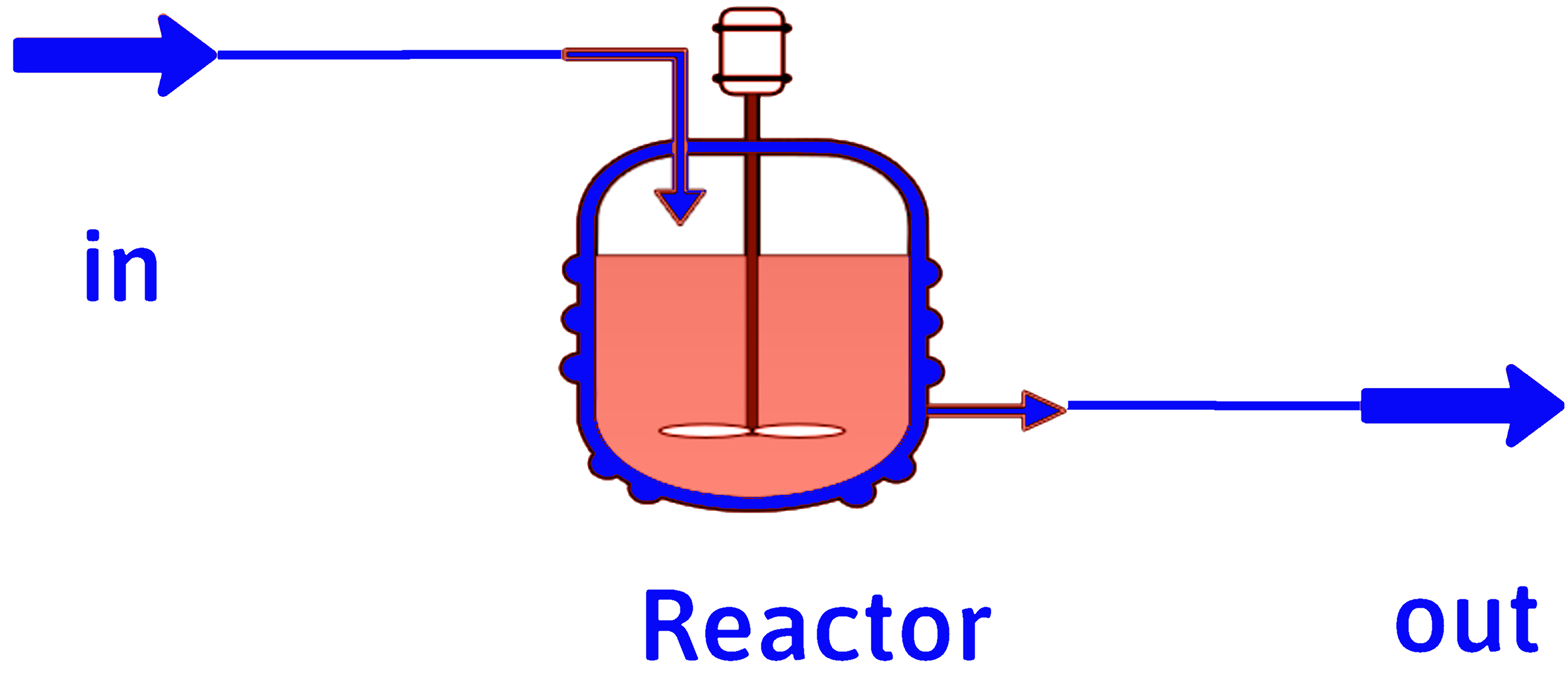
Reactor Mole Balance Equation

\(\dot{n}_{i_\mathrm{in}}\)

\(\dot{n}_{i_\mathrm{in}}\)


Differential Balance
e.g., open, steady state

\[ \dot{n}_{i_\mathrm{out}} = \dot{n}_{i_\mathrm{in}} + \nu_i \dot{\xi} \]

\[ \dot{n}_\mathrm{out} = \dot{n}_\mathrm{in} + \nu \dot{\xi} \]

\[ \dot{n}_\mathrm{in} = \sum \dot{n}_{i_\mathrm{in}} \]

\[ \dot{n}_\mathrm{out} = \sum \dot{n}_{i_\mathrm{out}} \]

\[ \nu = \sum \nu_i \]

Integral Balance
e.g., closed

\[ n_{i_\mathrm{out}} = n_{i_\mathrm{in}} + \nu_i \xi \]

\[ n_\mathrm{out} = n_\mathrm{in} + \nu \xi \]

\[ n_\mathrm{in} = \sum n_{i_\mathrm{in}} \]

\[ n_\mathrm{out} = \sum n_{i_\mathrm{out}} \]

\[ \nu = \sum \nu_i \]

Stoichiometric Coefficient Example

Remember

\(\nu_i\) is positive for product.

\(\nu_i\) is negative for reactant.

\(\nu_i\) is zero for inerts.

\[ 8 \mathrm{N_2} + 2 \mathrm{O_2} + 2 \mathrm{C} \rightarrow 8 \mathrm{N_2} + 2 \mathrm{CO_2} \]

\[ \nu_{\mathrm{O}_2} = -2 \]

\[ \nu_\mathrm{C} = -2 \]

\[ \nu_{\mathrm{CO_2}} = 2 \]

\[ \nu_{\mathrm{N}_2} = -8+8=0 \]

\[ \nu = 8 + 2 - 8 - 2 - 2 = -2 \]

Fractional Conversion of Reactant k

Differential Balance

\[ f_k = \frac{\dot{n}_{k_\mathrm{in}} - \dot{n}_{k_\mathrm{out}}}{\dot{n}_{k_\mathrm{in}}} \]

\[ = 1- \frac{\dot{n}_{k_\mathrm{out}}}{\dot{n}_{k_\mathrm{in}}} \]

\[ = \frac{-\nu_k \dot{\xi}}{\dot{n}_{k_\mathrm{in}}} \]

\[ \implies \dot{\xi} = \frac{f_k \dot{n}_{k_\mathrm{in}}}{-\nu_k} \]

Integral Balance

\[ f_k = \frac{n_{k_\mathrm{in}} - n_{k_\mathrm{out}}}{n_{k_\mathrm{in}}} \]

\[ = 1- \frac{n_{k_\mathrm{out}}}{n_{k_\mathrm{in}}} \]

\[ = \frac{-\nu_k \xi}{n_{k_\mathrm{in}}} \]

\[ \implies \xi = \frac{f_k n_{k_\mathrm{in}}}{-\nu_k} \]

Fractional conversion only works for reactants, not products. Unlike extent of reaction, in general it is different for each reactant.

Limiting Reactant

\[ \nu_\mathrm{A} \mathrm{A} + \nu_\mathrm{B} \mathrm{B} \rightarrow \cdots \]

If we had 100% conversion of \(\mathrm{A}\),

\[ \dot{\xi} = \frac{\dot{n}_{\mathrm{A_{in}}}}{-\nu_\mathrm{A}} \text{ or } \xi = \frac{n_{\mathrm{A_{in}}}}{-\nu_\mathrm{A}} \]

If we had 100% conversion of \(\mathrm{B}\),

\[ \dot{\xi} = \frac{\dot{n}_{\mathrm{B_{in}}}}{-\nu_\mathrm{B}} \text{ or } \xi = \frac{n_{\mathrm{B_{in}}}}{-\nu_\mathrm{B}} \]


The reactant yielding the smallest value for \(\xi\) is the limiting reactant. All other reactants are excess reactants.

The fractional excess is the fraction in excess of stoichiometric.

\[ \mathrm{frac.\ xs} = \frac{n_{k_\mathrm{feed}} - n_{k_\mathrm{stoic}}}{n_{k_\mathrm{stoic}}} \]

Important

These numbers are calculated regardless of the actual extent of reaction or fractional conversion in the process.

Limiting Reactant Example

\[ \mathrm{N_2+3H_2 \rightarrow 2NH_3} \]

If \(\dot{n}_\mathrm{N_2in}= 100\ \mathrm{mol/s}\) and \(\dot{n}_\mathrm{H_2in}= 200\ \mathrm{mol/s}\),

Then

\[ \frac{200}{3} < \frac{100}{1} \]

and \(\mathrm{H_2}\) is the limiting reactant.

Also \(\dot{\xi} = \frac{200}{3}\) for 100% conversion of \(\mathrm{H_2}\)

and \(\dot{n}_\mathrm{N_2stoic}=\dot{\xi}(-\nu_\mathrm{N_2}) = \frac{200}{3}(1)\).

So the fractional excess of \(\mathrm{N_2}\) is

\[ \frac{\dot{n}_\mathrm{N_2in} - \dot{n}_\mathrm{N_2stoic}}{\dot{n}_\mathrm{N_2stoic}} = \frac{100-\frac{200}{3}}{\frac{200}{3}} = \frac{1}{2} = 50\% \]

The Takeaways

  1. Stoichiometric coefficients for reactants are negative and for products are positive.
  2. The mole balance for a given species in a reactor is that the output is the input plus the stoichiometric coefficient for that species times the extent of reaction.
  3. Fractional conversion is for reactants only and is the fraction of the reactant converted to products in the reactor.
  4. The limiting reactant is the one that would be totally consumed first it the reaction went to completion. All other reactants are excess reactants.


Thanks for watching!
The Full Story companion video is in the link in the upper left. When You Saw It, What Was the Extent of Your Reaction? Part 2, the next video in the series, is in the upper right. To learn more about Chemical and Thermal Processes, visit the website linked in the description.