Mole Balance for Multiple Reactions
![]()
\(\dot{n}_{i_\mathrm{in}}\)
\(\dot{n}_{i_\mathrm{in}}\)
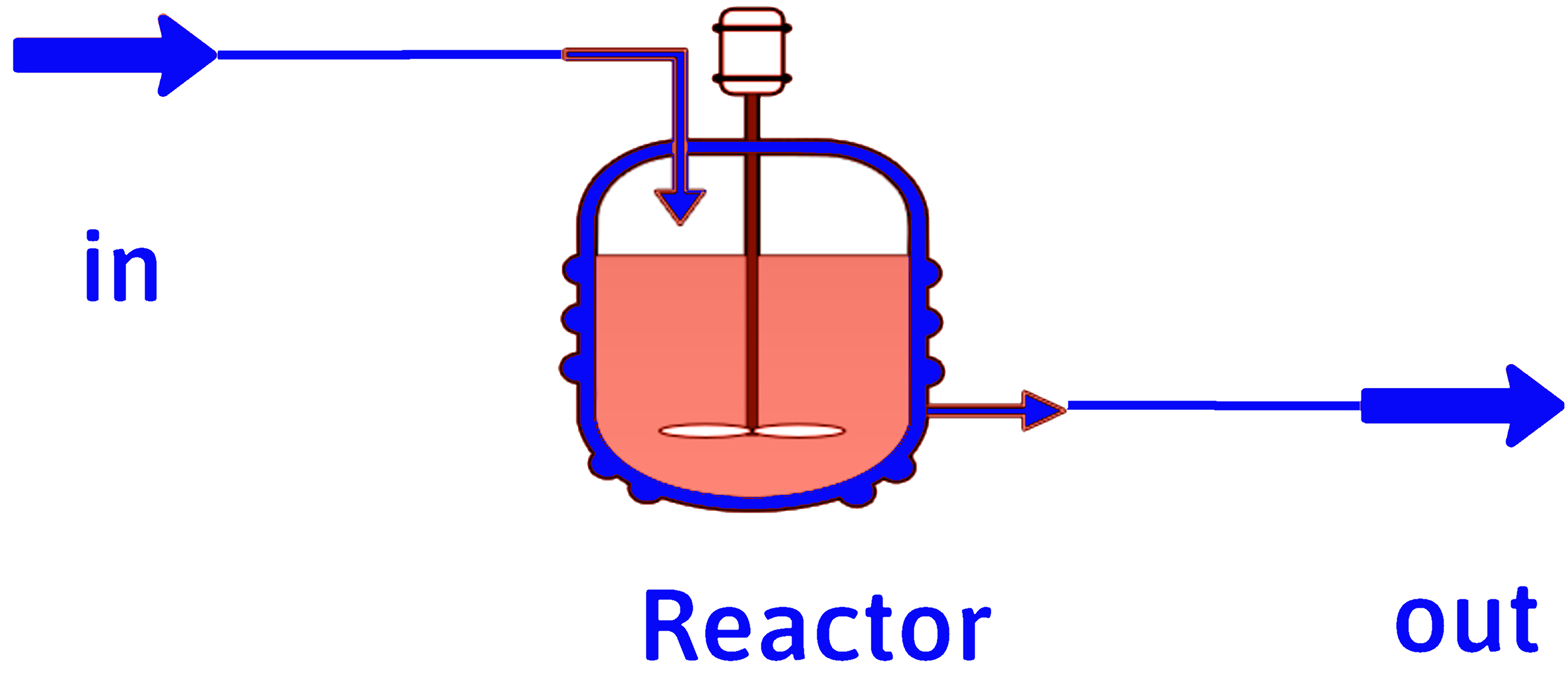
Differential Balance
\[
\dot{n}_{i_\mathrm{out}} = \dot{n}_{i_\mathrm{in}} + \sum_{j=1}^J \nu_{ij} \dot{\xi}_j
\]
\[
\dot{n}_\mathrm{out} = \dot{n}_\mathrm{in} + \sum_{j=1}^J \nu_{j} \dot{\xi}_j
\]
Integral Balance
\[
n_{i_\mathrm{out}} = n_{i_\mathrm{in}} + \sum_{j=1}^J \nu_{ij} \xi_j
\]
\[
n_\mathrm{out} = n_\mathrm{in} + \sum_{j=1}^J \nu_{j} \xi_j
\]
\(\nu_{ij}\) is the stoichiometric coefficient for reactant \(i\) in reaction \(j\).
\(\nu_{j}\) is the overall stoichiometric coefficient for reaction \(j\).
\(\dot{\xi}_j,\ \xi_j\) is the extent of reaction j.
Solution (cont.)
The full set of multiple reaction mole balances with Equation 1 and Equation 2 is
\[
\dot{n}_\mathrm{C_3H_8out} = \dot{n}_\mathrm{C_3H_8in} - \dot{\xi}_1 - \dot{\xi}_2 \implies \dot{\xi}_1 + \dot{\xi}_2 = 2\ \mathrm{kmol/s}
\]
\[
\dot{n}_\mathrm{CO_2out} = \dot{n}_\mathrm{CO_2in} + 3\dot{\xi}_1 + 0 \boldsymbol{\cdot} \dot{\xi}_2 \implies \dot{n}_\mathrm{CO_2out} = 3\dot{\xi}_1
\]
\[
\dot{n}_\mathrm{COout} = \dot{n}_\mathrm{COin} + 0 \boldsymbol{\cdot} \dot{\xi}_1 + 3 \dot{\xi}_2 \implies \dot{n}_\mathrm{COout} = 3\dot{\xi}_2
\]
\[
\dot{n}_\mathrm{O_2out} = \dot{n}_\mathrm{O_2in} - 5\dot{\xi}_1 - 3.5 \dot{\xi}_2 = 12.50\ \mathrm{kmol/s} - 5\dot{\xi}_1 - 3.5 \dot{\xi}_2
\]
\[
\dot{n}_\mathrm{H_2Oout} = \dot{n}_\mathrm{H_2Oin} + 4 \dot{\xi}_1 + 4 \dot{\xi}_2 = 4 \dot{\xi}_1 + 4 \dot{\xi}_2
\]
Five equations in six unknowns, \(\dot{\xi}_1\), \(\dot{\xi}_2\), \(\dot{n}_\mathrm{CO_2out}\), \(\dot{n}_\mathrm{COout}\), \(\dot{n}_\mathrm{O_2out}\), and \(\dot{n}_\mathrm{H_2Oout}\).
Solution (cont.)
Applying the \(\mathrm{CO_2}\)-to-\(\mathrm{CO}\) constraint
\[
\frac{\dot{n}_\mathrm{COout}}{\dot{n}_\mathrm{CO_2out}} = \frac{1 - 0.80}{0.80}=0.25 = \frac{3\dot{\xi}_2}{3\dot{\xi}_1} = \frac{\dot{\xi}_2}{\dot{\xi}_1}
\]
\[
\dot{\xi}_1 + \dot{\xi}_2 = 2\ \mathrm{kmol/s} = \dot{\xi}_1 + 0.25 \dot{\xi}_1 = 1.25 \dot{\xi}_1
\]
\[
\implies \dot{\xi}_1 = 1.6\ \mathrm{kmol/s},\ \dot{\xi}_2 = 0.4\ \mathrm{kmol/s}
\]
\[
\implies \dot{n}_\mathrm{CO_2out} = 3 \boldsymbol{\cdot} 1.6\ \mathrm{kmol/s} = 4.8\ \mathrm{kmol/s},
\]
\[
\dot{n}_\mathrm{COout} = 3 \boldsymbol{\cdot} 0.4\ \mathrm{kmol/s} = 1.2\ \mathrm{kmol/s}
\]
\[
\dot{n}_\mathrm{O_2out} = 12.5\ \mathrm{kmol/s} - 5 \boldsymbol{\cdot} 1.6 - 3.5 \boldsymbol{\cdot} 0.4 = 3.10\ \mathrm{kmol/s}
\]
\[
\dot{n}_\mathrm{H_2Oout} = 4 \boldsymbol{\cdot} 1.6 + 4 \boldsymbol{\cdot} 0.4 = 8.00\ \mathrm{kmol/s}
\]
Solution (cont.)
Solve for the total molar output flow rate two different ways. Sum the output flows
\(\dot{n}_\mathrm{CO_2out} + \dot{n}_\mathrm{COout} + \dot{n}_\mathrm{O_2out}+\dot{n}_\mathrm{H_2Oout} = 4.8+1.2 +3.1+8\) \(\ \ \ \ \ \ \ \ \ \ \ \ \ \ \ \ \ \ \ \ \ \ \ \ \ \ \ \ \ \ \ \ \ \ \ \ \ \ \ \ \ \ \ \ \ \ \ \ \ \ \ \ \ \ \ \ \ \ \ \ \ = 17.1\ \mathrm{kmol/s}\)
or calculate the overall stoichiometric coefficients and use the equation for overall flows
\[
\nu_1 = 3 + 4 -1 - 5 = 1
\]
\[
\nu_2 = 3 + 4 -1 - \frac{7}{2} = 2.5
\]
\[
\dot{n}_\mathrm{in} = \dot{n}_\mathrm{C_3H_8in} + \dot{n}_\mathrm{O_2in} = 2 + 12.5 = 14.5\ \mathrm{kmol/s}
\]
\(\dot{n}_\mathrm{out} = \dot{n}_\mathrm{out} + 1 \boldsymbol{\cdot} \dot{\xi}_1 + 2.5 \dot{\xi}_1 = 14.5 + 1.6 + 2.5\boldsymbol{\cdot} 0.4\) \(\ \ \ \ \ \ = 17.1\ \mathrm{kmol/s}\)