The Symbolic Meaning
of Recycling
Just the Facts
DOFPro Team
Recycle Example Symbolic Only
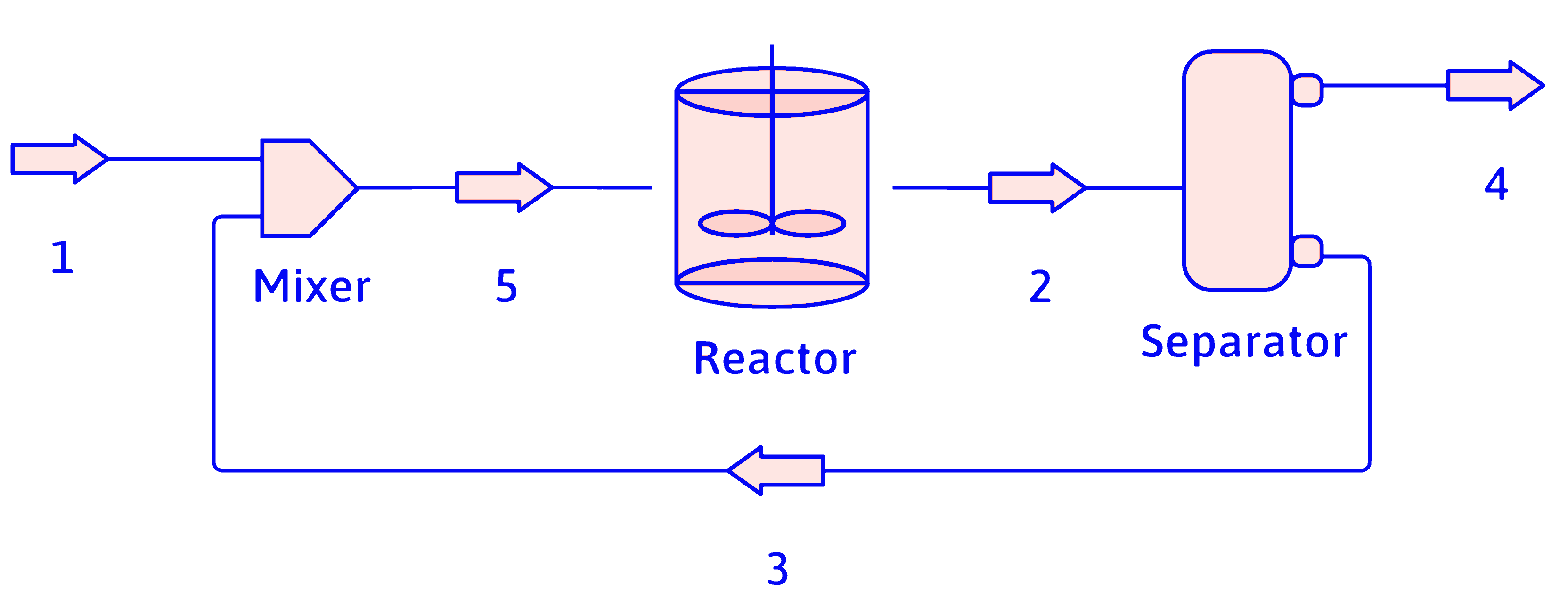
\(\nu_\mathrm{A} \mathrm{A} \rightarrow \nu_\mathrm{B} \mathrm{B} + \nu_\mathrm{C} \mathrm{C}\)
\(\mathrm{A}\)
\(\begin{array}{c}\mathrm{A}\\\mathrm{B}\\\mathrm{C}\end{array}\)
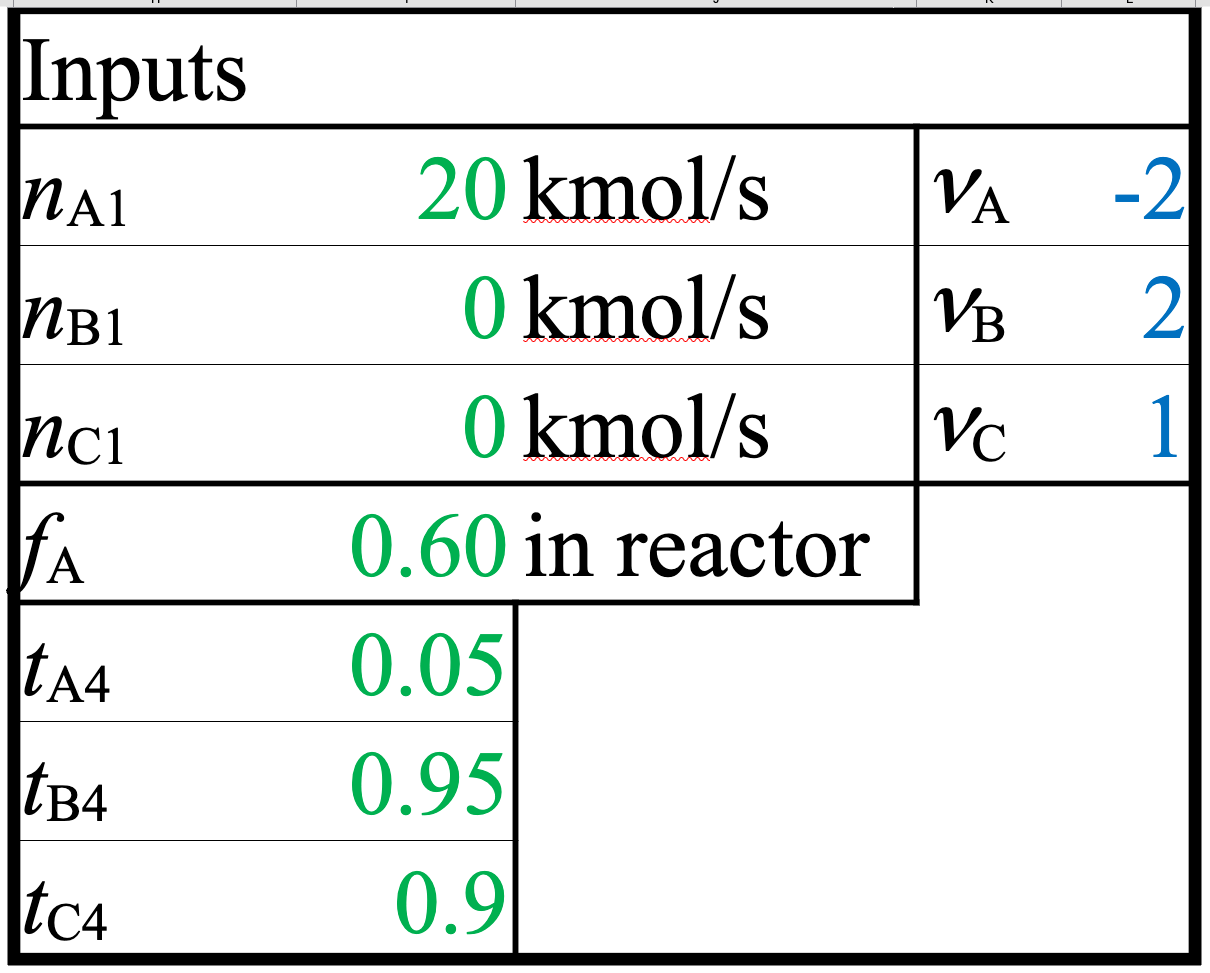
Assume that the knowns or givens are:
\(\dot{n}_\mathrm{A1}\), \(\dot{n}_\mathrm{B1}\), \(\dot{n}_\mathrm{C1}\),
\(f_\mathrm{A}\) (in reactor),
\(t_\mathrm{A4}\), \(t_\mathrm{C4}\), \(t_\mathrm{C4}\)
Find a full set of equations for all of the flows, extent of reaction, and overall conversion in terms of the knowns.
In general, you have to calculate a set of mass balances completely around the recycle loop before you can eliminate the unknowns. Each known will be circled, and each equation that has a single unknown in terms of knowns will be circled.
“A” Balance
\(\nu_\mathrm{A} \mathrm{A} \rightarrow \nu_\mathrm{B} \mathrm{B} + \nu_\mathrm{C} \mathrm{C}\)
\(\mathrm{A}\)
\(\begin{array}{c}\mathrm{A}\\\mathrm{B}\\\mathrm{C}\end{array}\)
Input
\(\ \ \ \ \dot{n}_\mathrm{A1} = \mathrm{given}\)
Mixer
\(\ \ \ \ \dot{n}_\mathrm{A5} = \dot{n}_\mathrm{A1} + \dot{n}_\mathrm{A3}\)
Reactor
\(\ \ \ \ \dot{n}_\mathrm{A2} = (1-f_\mathrm{A})\dot{n}_\mathrm{A5} = (1-f_\mathrm{A})(\dot{n}_\mathrm{A1} + \dot{n}_\mathrm{A3})\)
\(\ \ \ \ \dot{n}_\mathrm{A2} = \dot{n}_\mathrm{A5} + \nu_\mathrm{A} \dot{\xi} = \dot{n}_\mathrm{A1} + \dot{n}_\mathrm{A3}+ \nu_\mathrm{A} \dot{\xi}\)
or
\(\ \ \ \ \dot{\xi} = (\dot{n}_\mathrm{A2} - \dot{n}_\mathrm{A5})/\nu_\mathrm{A}\)
Separator
\(\ \ \ \ \dot{n}_\mathrm{A4} = t_\mathrm{A4} \dot{n}_\mathrm{A2} = t_\mathrm{A4} (1-f_\mathrm{A}) (\dot{n}_\mathrm{A1} + \dot{n}_\mathrm{A3})\)
\(\ \ \ \ \dot{n}_\mathrm{A3} = (1-t_\mathrm{A4}) \dot{n}_\mathrm{A2} = (1-t_\mathrm{A4}) (1-f_\mathrm{A}) (\dot{n}_\mathrm{A1} + \dot{n}_\mathrm{A3})\)
“A” Balance (cont.)
\(\nu_\mathrm{A} \mathrm{A} \rightarrow \nu_\mathrm{B} \mathrm{B} + \nu_\mathrm{C} \mathrm{C}\)
\(\mathrm{A}\)
\(\begin{array}{c}\mathrm{A}\\\mathrm{B}\\\mathrm{C}\end{array}\)
Separator (cont.)
\(\ \ \ \ \dot{n}_\mathrm{A3} = (1-t_\mathrm{A4}) (1-f_\mathrm{A}) (\dot{n}_\mathrm{A1} + \dot{n}_\mathrm{A3})\)
\(\ \ \ \ \implies \dot{n}_\mathrm{A3} = \dot{n}_\mathrm{A1} \left[\frac{(1-f_\mathrm{A}) (1-t_\mathrm{A4})}{f_\mathrm{A} + t_\mathrm{A4} - f_\mathrm{A} t_\mathrm{A4}}\right]\)
Once we have \(\dot{n}_\mathrm{A3}\),
\(\ \ \ \ \dot{n}_\mathrm{A5} = \dot{n}_\mathrm{A1} + \dot{n}_\mathrm{A3}\)
\(\ \ \ \ \dot{n}_\mathrm{A2} = (1-f_\mathrm{A}) \dot{n}_\mathrm{A5}\)
\(\ \ \ \ \dot{\xi} = (\dot{n}_\mathrm{A2} - \dot{n}_\mathrm{A5})/\nu_\mathrm{A}\)
“B” & “C” Balances
\(\nu_\mathrm{A} \mathrm{A} \rightarrow \nu_\mathrm{B} \mathrm{B} + \nu_\mathrm{C} \mathrm{C}\)
\(\mathrm{A}\)
\(\begin{array}{c}\mathrm{A}\\\mathrm{B}\\\mathrm{C}\end{array}\)
For \(\mathrm{B}\) and \(\mathrm{C}\) we’ll use extent of reaction. The \(\mathrm{B}\) and \(\mathrm{C}\) equations are identical except for the change from \(\mathrm{B}\) to \(\mathrm{C}\) subscripts.
Overall
\(\ \ \ \ \dot{n}_\mathrm{B4} = \dot{n}_\mathrm{B1} + \nu_\mathrm{B} \dot{\xi}\)
\(\ \ \ \ \dot{n}_\mathrm{C4} = \dot{n}_\mathrm{C1} + \nu_\mathrm{C} \dot{\xi}\)
Separator
\(\ \ \ \ \dot{n}_\mathrm{B2} = \frac{\dot{n}_\mathrm{B4}}{t_\mathrm{B4} }\)
\(\ \ \ \ \dot{n}_\mathrm{C2} = \frac{\dot{n}_\mathrm{C4}}{t_\mathrm{C4} }\)
\(\ \ \ \ \dot{n}_\mathrm{B3} = (1-t_\mathrm{B4}) \dot{n}_\mathrm{B2} = \frac{1-t_\mathrm{B4}}{t_\mathrm{B4}} \dot{n}_\mathrm{B4}\)
\(\ \ \ \ \dot{n}_\mathrm{C3} = (1-t_\mathrm{C4}) \dot{n}_\mathrm{C2} = \frac{1-t_\mathrm{C4}}{t_\mathrm{C4}} \dot{n}_\mathrm{C4}\)
Mixer
\(\ \ \ \ \dot{n}_\mathrm{B5} = \dot{n}_\mathrm{B1} + \dot{n}_\mathrm{B3}\)
\(\ \ \ \ \dot{n}_\mathrm{C5} = \dot{n}_\mathrm{C1} + \dot{n}_\mathrm{C3}\)
Summary
\(\nu_\mathrm{A} \mathrm{A} \rightarrow \nu_\mathrm{B} \mathrm{B} + \nu_\mathrm{C} \mathrm{C}\)
\(\mathrm{A}\)
\(\begin{array}{c}\mathrm{A}\\\mathrm{B}\\\mathrm{C}\end{array}\)
Finally, the overall fractional conversion of \(\mathrm{A}\), and the product flow rates
Overall Fractional Conversion
\(\ \ \ \ f_\text{A–overall} = 1-\frac{\dot{n}_\mathrm{A1}}{\dot{n}_\mathrm{A4}} = \frac{f_\mathrm{A}}{f_\mathrm{A} + t_\mathrm{A4} - f_\mathrm{A} t_\mathrm{A4}}\)
Output Flows (from overall and \(\dot{\xi}\))
\(\ \ \ \ \dot{n}_\mathrm{A4} = \dot{n}_\mathrm{A1} + \nu_\mathrm{A} \dot{\xi}\)
\(\ \ \ \ \dot{n}_\mathrm{B4} = \dot{n}_\mathrm{B1} + \nu_\mathrm{B} \dot{\xi}\)
\(\ \ \ \ \dot{n}_\mathrm{C4} = \dot{n}_\mathrm{C1} + \nu_\mathrm{C} \dot{\xi}\)
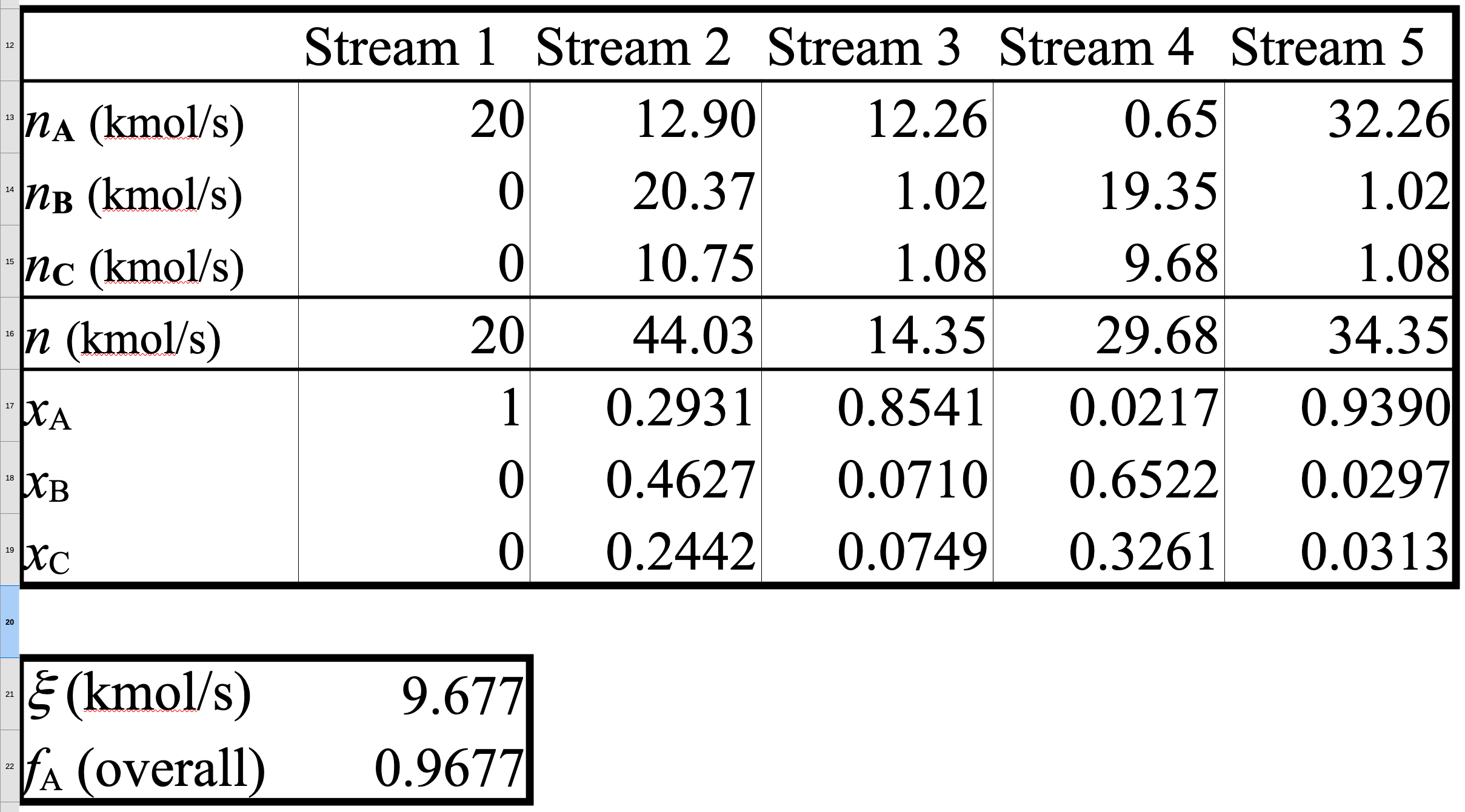
Spreadsheet Summary
\(\nu_\mathrm{A} \mathrm{A} \rightarrow \nu_\mathrm{B} \mathrm{B} + \nu_\mathrm{C} \mathrm{C}\)
\(\mathrm{A}\)
\(\begin{array}{c}\mathrm{A}\\\mathrm{B}\\\mathrm{C}\end{array}\)
Parametric Plot of \(f_\text{A–overall}\)
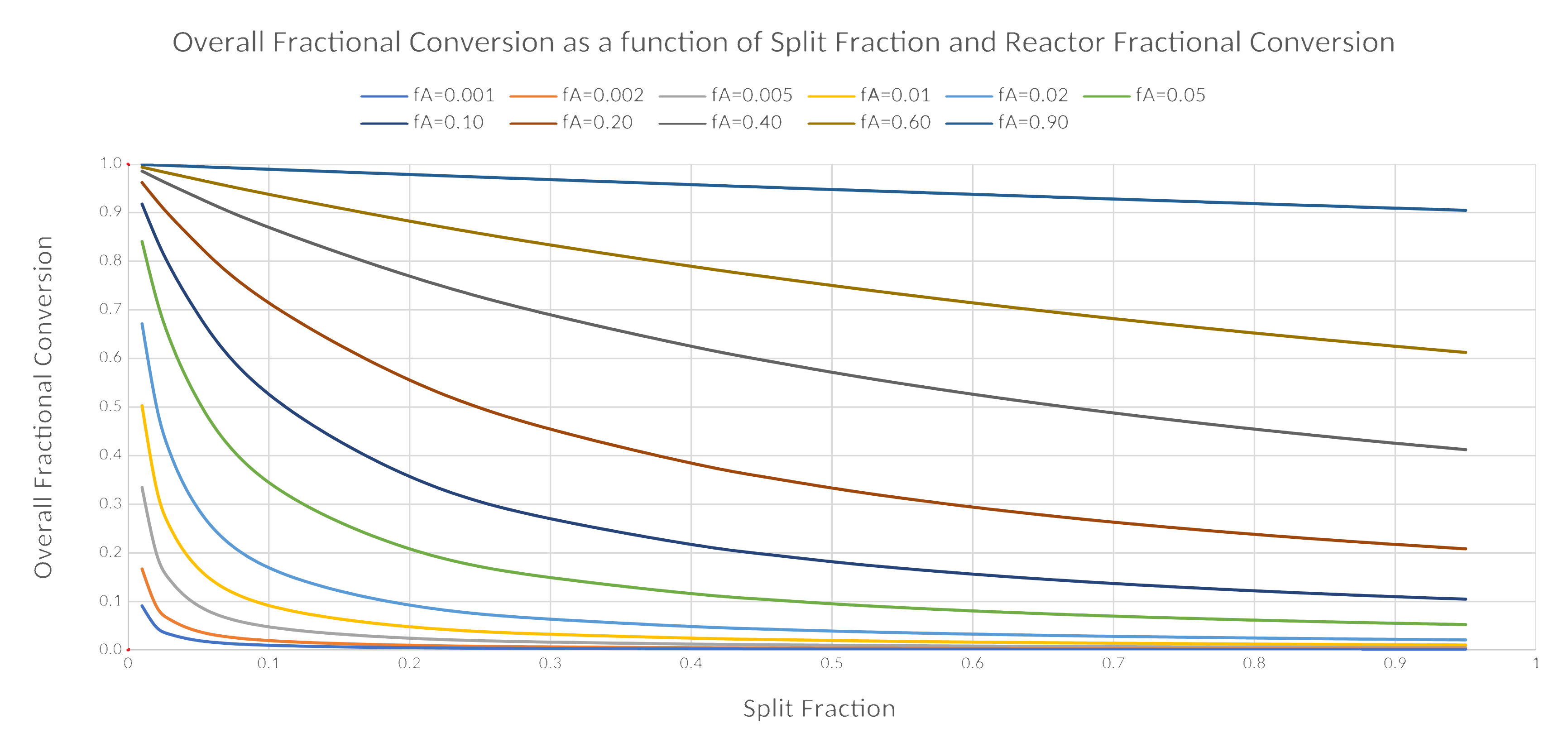
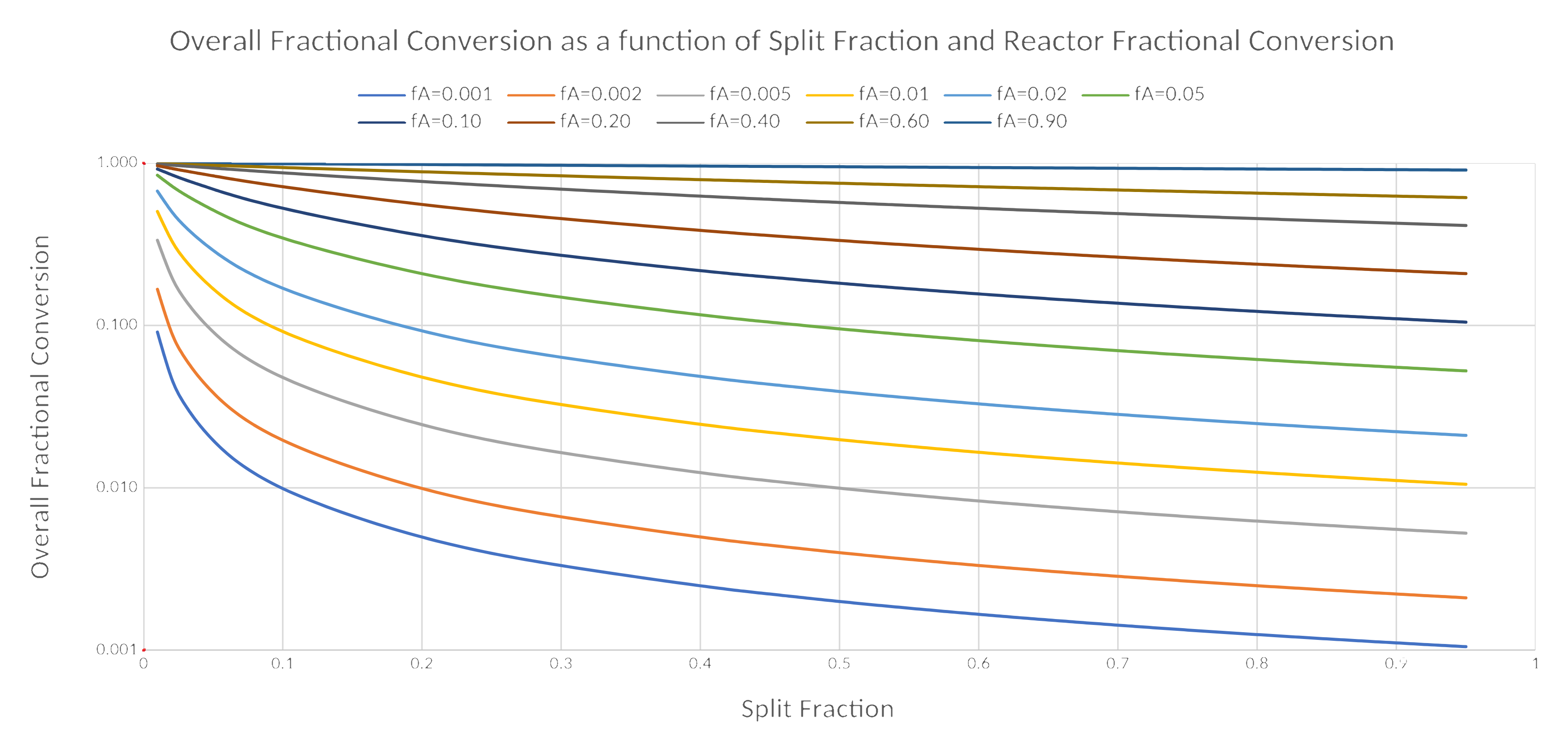
Linear
Scale
Log
Scale
Thanks for watching!
The Full Story companion video is in the link in the upper left. The next video in the series, How Did You Think I Would React?, is in the upper right. To learn more about Chemical and Thermal Processes, visit the website linked in the description.