DOFPro Team

\[ K\ (\mathrm{1\ bar})^\nu P^{-\nu} =\prod (y_i)^{\nu_i} \]
\[ K = \exp \left( - \frac{\Delta G^\circ}{RT}\right) \]
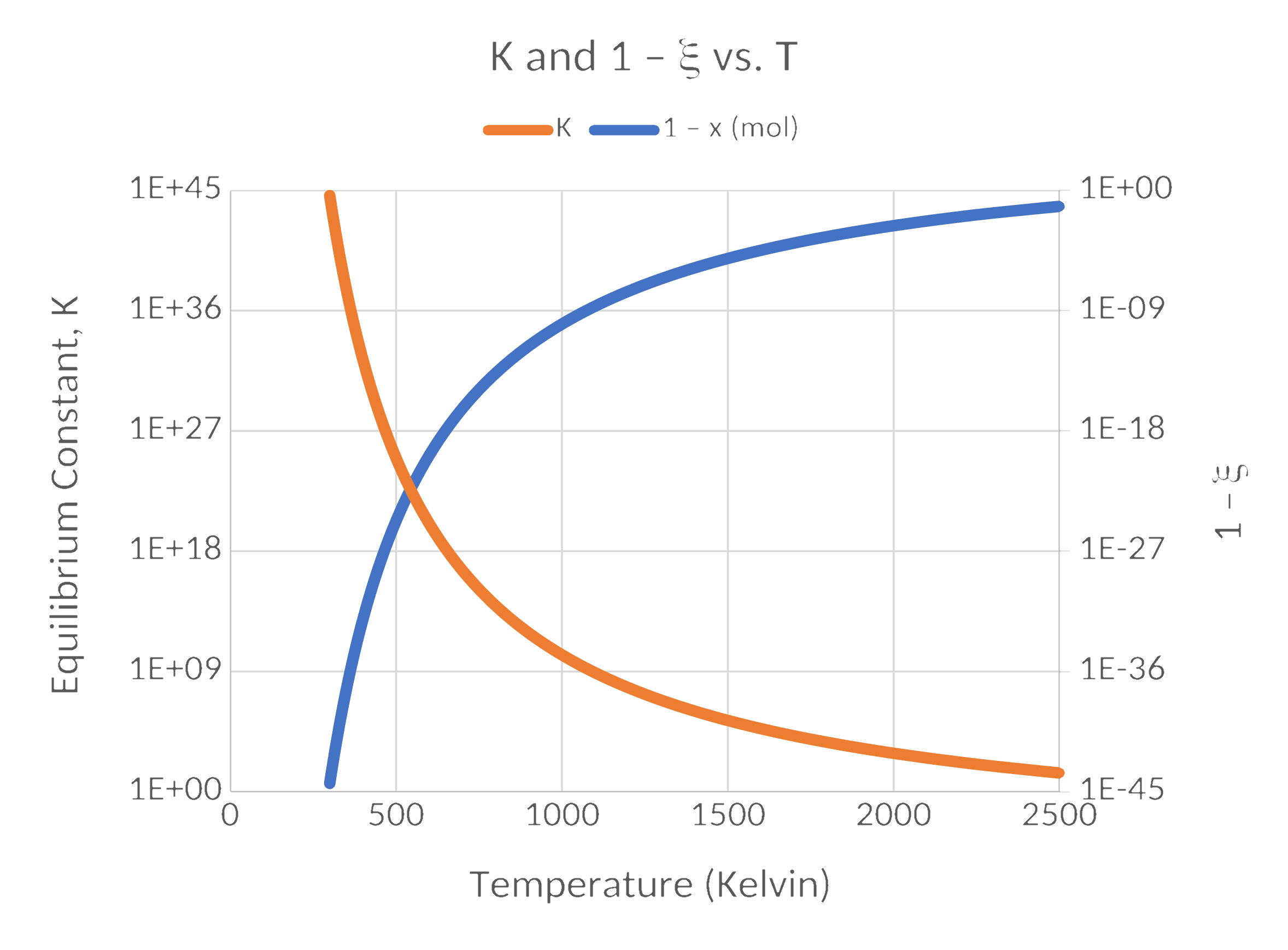
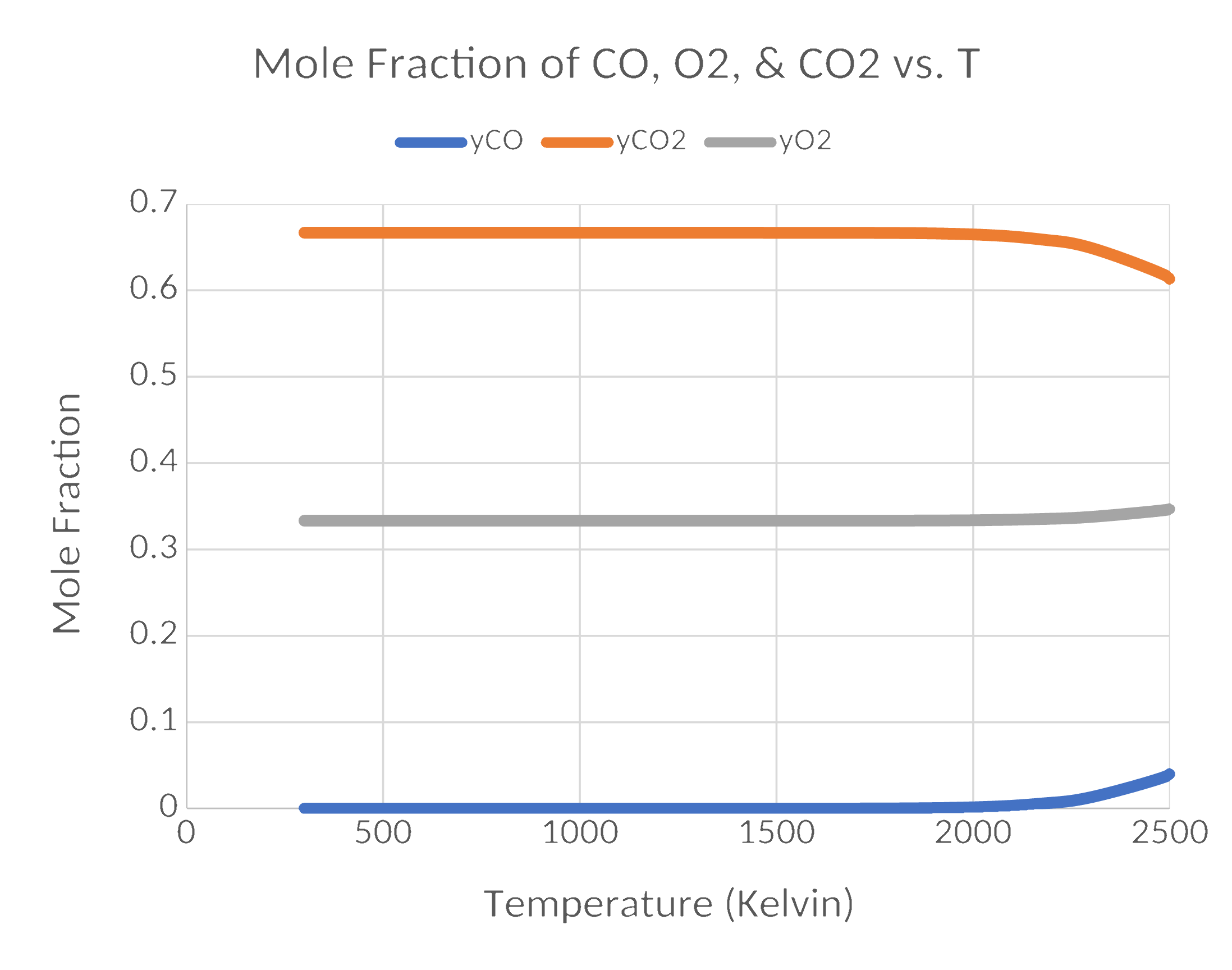
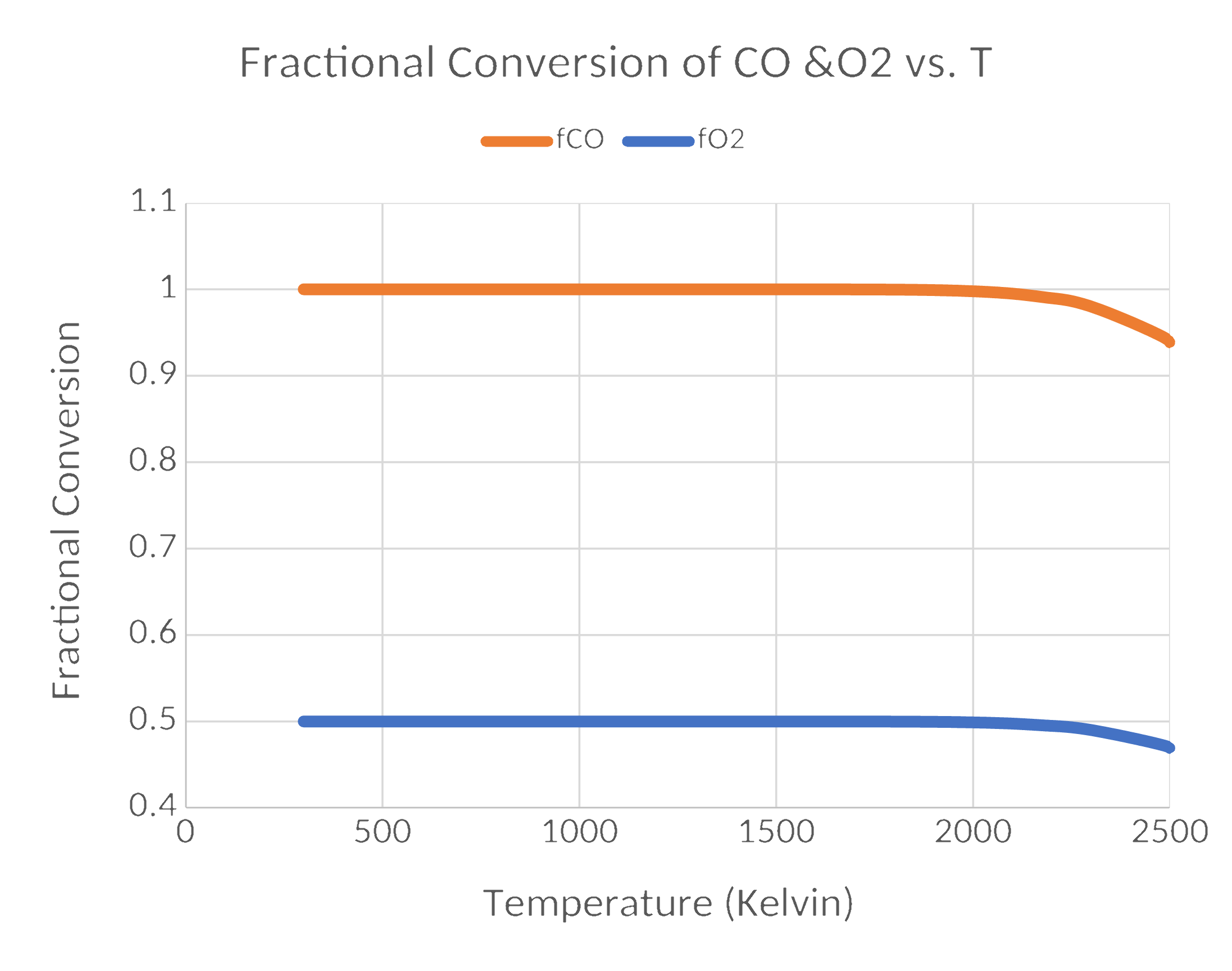
Carbon monoxide and oxygen are fed in equimolar ratios to an isothermal combustor. If the reaction proceeds to equilibrium calculate the fractional conversion of \(\mathrm{CO}\) and \(\mathrm{O_2}\) as the reactor temperature varies from \(300\ \mathrm{K}\) to \(2500\ \mathrm{K}\).
\(\ \ \ \ \mathrm{CO +\frac{1}{2} O_2 = CO_2}\)
\(\ \ \ \ \Delta G^\circ = -281,885 + 85.678 T\ \mathrm{[J/mol]}\)
\[ \ln K = - \frac{\Delta G^\circ}{RT} = \frac{33,903}{T} - 10.3047 \]
\[ \nu_\mathrm{CO} = -1,\ \ \ \ \nu_{\mathrm{O_2}} = -0.5,\ \ \ \ \nu_{\mathrm{CO_2}} = 1 \]
\[ \nu = -1 - 0.5 + 1 = -0.5 \]
\[ K\ (\mathrm{1\ bar})^\nu P^{-\nu} =\prod (y_i)^{\nu_i} \]
\[ K\ (\mathrm{1\ bar})^{-0.5} P^{0.5} = \frac{y_{\mathrm{CO}_2}}{y_{\mathrm{CO}} y^{0.5}_{\mathrm{O}_2}} \]
\[ y_\mathrm{CO} = \frac{n_\mathrm{CO_{out}}}{n_\mathrm{out}} = \frac{n_\mathrm{CO_{in}} + \nu_\mathrm{CO}\xi}{n_\mathrm{in} + \nu \xi} \]
\[ y_\mathrm{CO_2} = \frac{n_\mathrm{CO_{2_{out}}}}{n_\mathrm{out}} = \frac{n_\mathrm{CO_{2_{in}}} + \nu_\mathrm{CO_2}\xi}{n_\mathrm{in} + \nu \xi} \]
\[ y_\mathrm{O_2} = \frac{n_\mathrm{O_{2_{out}}}}{n_\mathrm{out}} = \frac{n_\mathrm{O_{2_{in}}} + \nu_\mathrm{O_2}\xi}{n_\mathrm{in} + \nu \xi} \]
What is missing?
\(P\) and either \(n_\mathrm{O_{2_{in}}}\) or \(n_\mathrm{CO_{in}}\).
Pick a basis of one mole.
Assume \(P = 1\ \mathrm{bar}\).
\[ \frac{\left(\frac{0+\xi}{2-0.5\xi}\right)}{\left(\frac{1-\xi}{2-0.5\xi}\right)\left(\frac{1-0.5\xi}{2-0.5\xi}\right)^{0.5}} = K(\mathrm{1\ bar})^{-0.5}(\mathrm{1\ bar})^{0.5} \]
\[
\frac{\left( 2 - 0.5 \xi \right)^{0.5}}{\left( 1-0.5 \xi \right)^{0.5}}\frac{\xi}{1-\xi} = K
\]
For \(\xi \rightarrow 0\), \(\xi = K/\sqrt{2}\).
For \(\xi \rightarrow 1\), \(\xi = \frac{K / \sqrt{3}}{1 + K / \sqrt{3}}\) or \(1 - \xi = \frac{1}{1+K/\sqrt{3}}\).
Thanks for watching!
The Full Story companion video is in the link in the upper left. The previous companion video, React But Maintain Your Equilibrium Part 1, in the series, is in the upper right. To learn more about Chemical and Thermal Processes, visit the website linked in the description.