Alcohol and Water DO Mix!

DOFPro Team

Variations with Temperature and Pressure

For most purposes solids and liquids are treated as incompressible, meaning the density is not a function of pressure. They are also regarded as having a low coefficient of thermal expansion, so variations of density with temperature are often ignored. However, it is not always safe to do so. For example, designing a liquid thermometer is impossible without a knowledge of how the density changes with temperature. From thermodynamics we have the volume expansivity

\[ \beta \equiv \frac{1}{V} \left( \frac{\partial V}{\partial T}\right)_P \]

and the isothermal compressibility

\[ \kappa \equiv - \frac{1}{V} \left( \frac{\partial V}{\partial P}\right)_T \]

Variations with Temperature and Pressure (cont.)


Values for \(\beta\) and \(\kappa\) come from experimental data, websites, handbooks, and tables, and equations of state. A web search can prove to be quite fruitful.

In later more advanced videos, we will discuss in more detail \(\beta\) and \(\kappa\) as well as partial molar volume, which is a method for calculating molar volumes for liquid mixtures.

Density of Mixtures of Liquids and Solids

For ideal mixtures (the attraction between like molecules is essentially the same as between unlike molecules) the density of a mixture can be calculated with volume additivity.

\[\hat{V}_\mathrm{mix} = \sum_{i=1}^n x_i \hat{V}_i\]

\[\hat{V} = \frac{1}{\rho}\]

\[\frac{1}{\rho_\mathrm{mix}} = \sum_{i=1}^n \frac{x_i}{\rho_i}\]

For a binary

\[\frac{1}{\rho_\mathrm{mix}} = \frac{x_1}{\rho_1}+\frac{1-x_1}{\rho_2}\]

\[\rho_\mathrm{mix} = \frac{\rho_1 \rho_2}{(1-x_1)\rho_1 + x_1 \rho_2}\]

Mixtures of aliphatic hydrocarbons are often close to ideal.

Density of Mixtures of Liquids and Solids (cont.)

Lacking any better information, you can use a density average

\[\rho_\mathrm{mix} = \sum_{i=1}^n x_i \rho_i\]

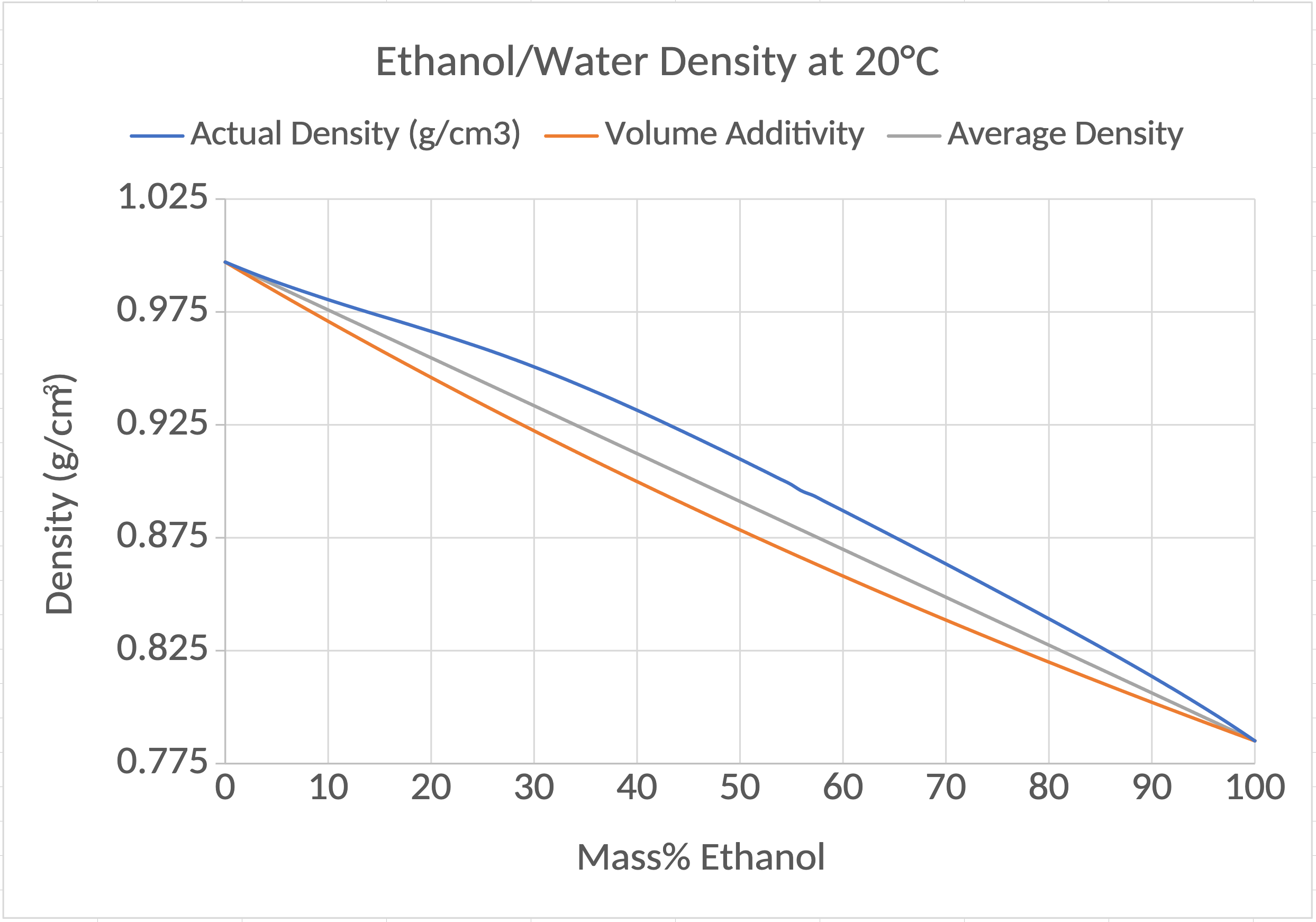
It would be really nice if the true values were bracketed by volume additivity and density average, but values can be way outside these two formulas. See ethanol and water on the next slide.

Experimental data, websites, handbooks, and tables, and equations of state are always your best bet if you can find them.

Example of Ethanol and Water

Volume Additivity \[\rho_\mathrm{mix} = \frac{\rho_1 \rho_2}{(1-x_1)\rho_1 + x_1 \rho_2}\]

Density Average \[\rho_\mathrm{mix} = x_1 \rho_1 + (1-x_1) \rho_2\]

The Takeaways

  1. Websites, handbooks, tables, and equations of state are the best sources for the density of liquid or solid mixtures.
  2. If the mixture is ideal, volume additivity should be fairly accurate.
  3. Lacking any other option, density average will at least give you a number.
  4. The densities of mixtures of ethanol and water lie way outside both volume additivity and density average.


Thanks for watching!
The Full Story companion video is in the link in the upper left. The next video in the series is in the upper right. To learn more about Chemical and Thermal Processes, visit the website linked in the description.