DOFPro Team

Dew Your Bubbles Have Flash?

Overall
Composition
Subcooled
Liquid
Superheated
Vapor
\(2\text{–}\phi\)
Flash Temperature
Flash
Pressure
Liquid
Composition
Vapor
Composition
\(a\)
\(b\)
\(\mathcal{V} = \dfrac{a}{a+b}\)
\(\mathcal{L} = 1-\mathcal{V} = \dfrac{b}{a+b}\)
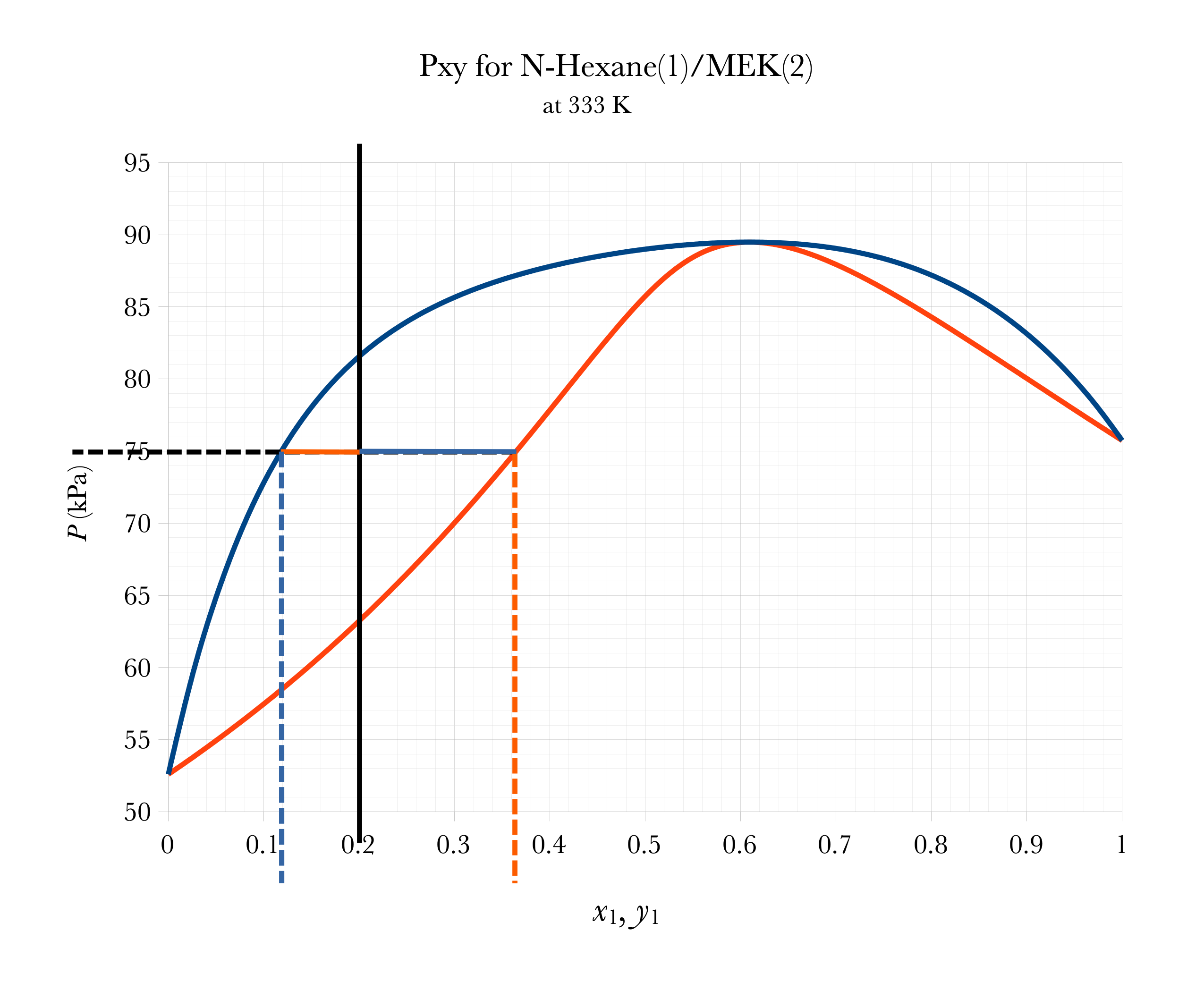
Given \(z_i\)’s and \(T\) and \(P\), calculate \(x_i\)’s and \(y_{i}\)’s, and relative amounts of vapor, \(\mathcal{V}\), and liquid, \(\mathcal{L}\).
\[ \mathcal{V} \equiv \frac{n_\mathrm{{vapor}}}{n_\mathrm{{total}}} \tag{1}\]
and
\[ \mathcal{L} \equiv \frac{n_\mathrm{{liquid}}}{n_\mathrm{{total}}} \tag{2}\]
so
\[ \mathcal{L} + \mathcal{V} = 1 \tag{3}\]
and
\[ z_{i} = x_{i}\mathcal{L} + y_{i}\mathcal{V}\ \ \ (i=1, 2, 3, ..., N) \tag{4}\]
or
\[ z_{i} = x_{i}(1-\mathcal{V}) + y_{i}\mathcal{V}\ \ \ (i= 1, 2, 3, ..., N) \tag{5}\]
We will now use the K-value or distribution coefficient, defined as
\[ K_{i} \equiv \frac{p_{i}^{*}}{P} \tag{6}\]
which for Raoult’s law yields
\[ K_{i} = \frac{y_i}{x_i} \tag{7}\]
or
\[ x_{i} = \frac{y_i}{K_i} \tag{8}\]
Substitution into Equation 5 yields
\[ y_{i} = \frac{z_{i}K_{i}}{1+\mathcal{V} (K_{i} - 1) }\ \ \ (i = 1, 2, 3, ..., N) \tag{9}\]
or
\[ \sum_{i=1}^{N} \frac{z_{i}K_{i}}{1 + \mathcal{V} (K_{i} -1)} = 1 \tag{10}\]
which is solved for \(\mathcal{V}\) by numerical methods (such as Goal Seek). Then find the \(y_{i}\) from Equation 9 and the \(x_{i}\) from Equation 8.
For a binary, there is an analytical method for solving for \(\mathcal{L}\) and \(\mathcal{V}\). Discovering the method is left as an exercise to the viewer.
The binary system benzene(1)/toluene(2) conforms closely to Raoult’s law. Vapor pressures for the pure species are given by the following Antoine equations:
\[ \log_{10} p_\mathrm{b}^{*} / \mathrm{bar} = 4.01814 - \frac{1203.835}{T /\mathrm{K} - 53.226} \]
\[ \log_{10}p_\mathrm{t}^{*} / \mathrm{bar} = 4.07827 - \frac{1343.943}{T / \mathrm{K} - 53.773} \]
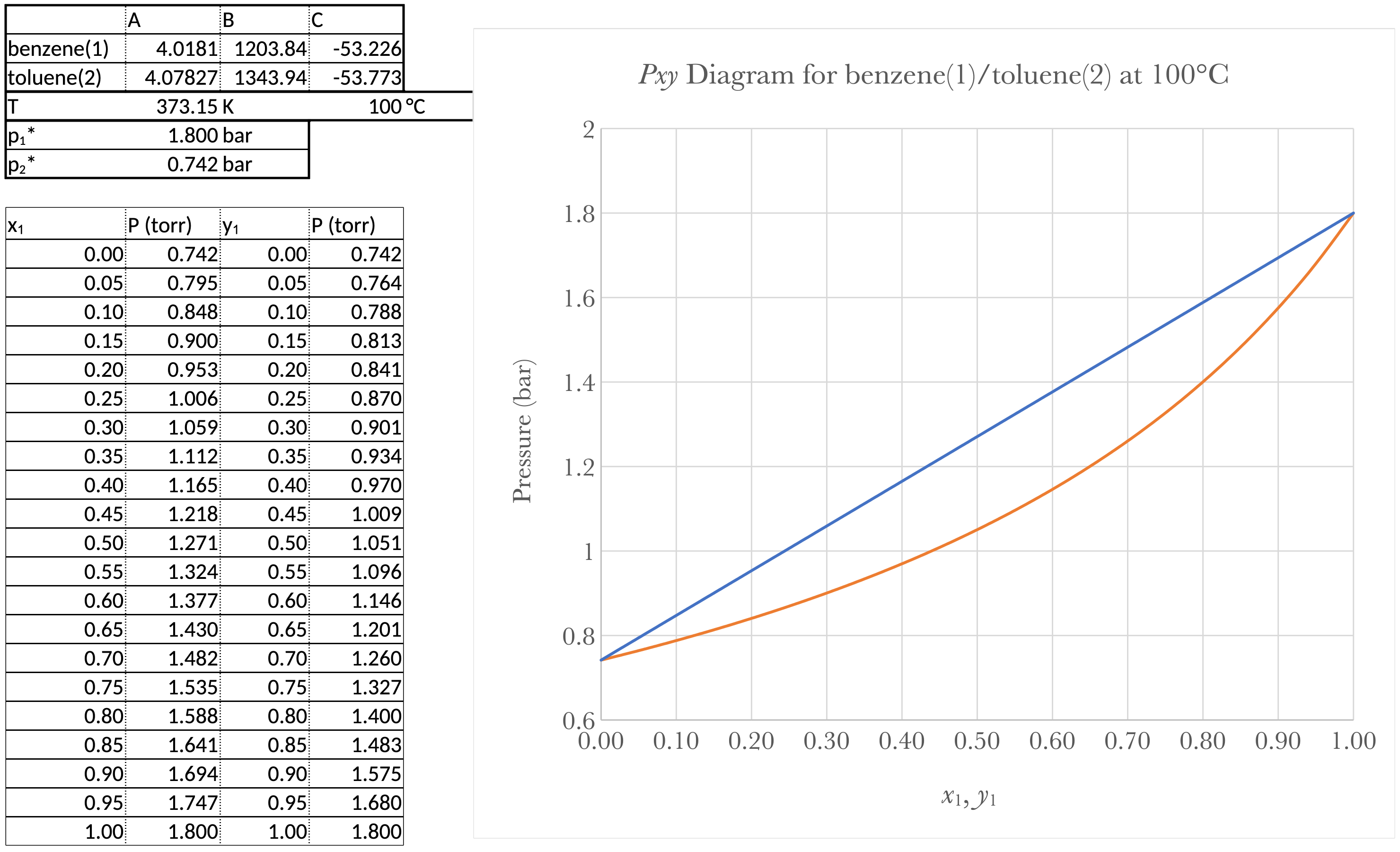
Prepare a graph showing \(P\) vs. \(x_b\) and \(P\) vs. \(y_b\) for a temperature of 100°C.
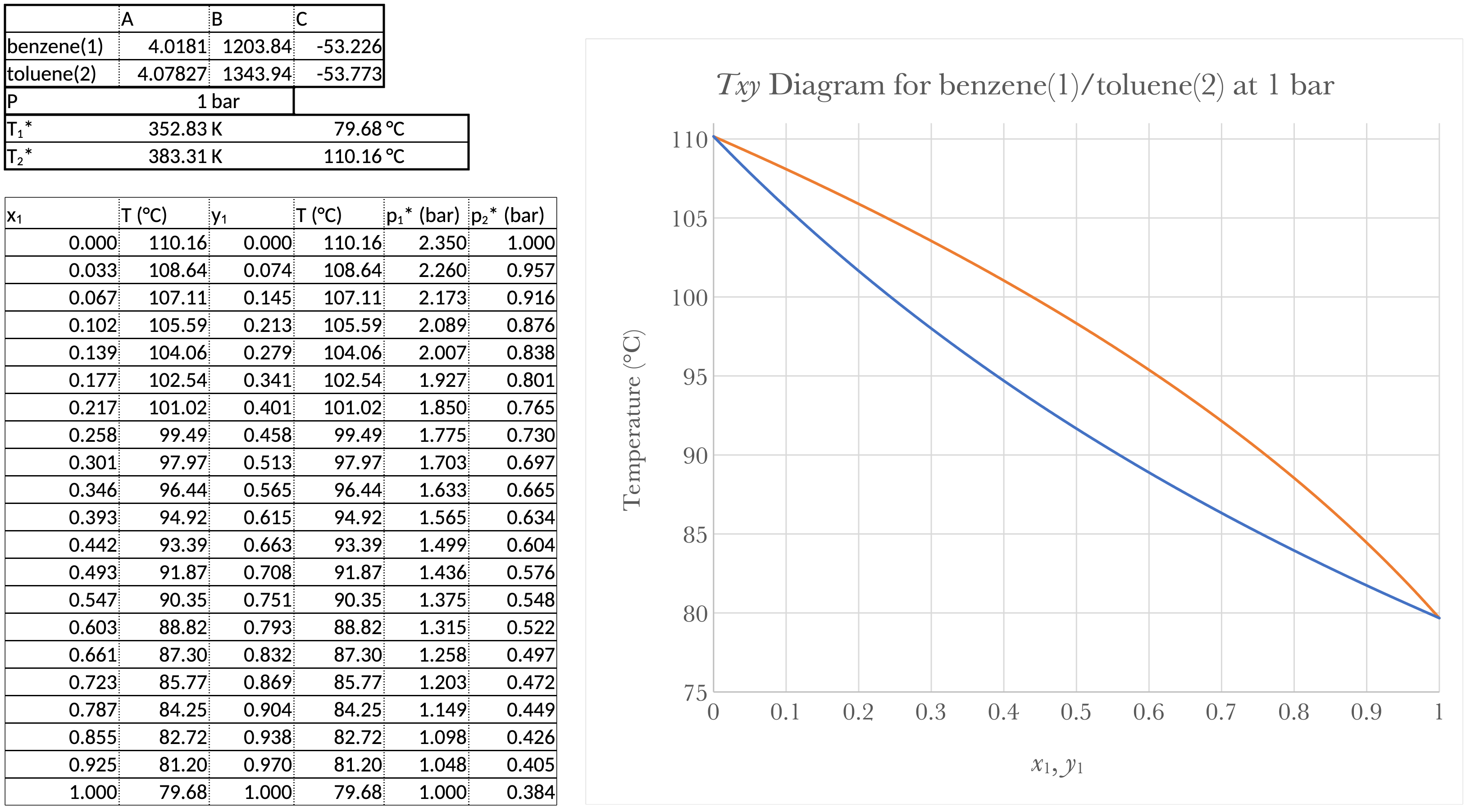
Prepare a graph showing \(T\) vs. \(x_b\) and \(T\) vs. \(y_b\) for a pressure of 1 bar
For a \(Pxy\) diagram, we need \(P\) as a function of \(x_1\), and \(P\) as a function of \(y_1\), or \(x_1\) and \(y_1\) as a function of \(P\). From ?@eq-BP3
\[ P = \sum_{i=1}^{N} x_{i}p_{i}^{*} + (1-x_{i})p_{2}^{*} = (p_{1}^{*} - p_{2}^{*}) x_1 + p_{2}^{*} \]
which is a linear function of \(x_1\) that runs from \(p_{2}^{*}\) at \(x_1\) = 0 to \(p_{1}^{*}\) at \(x_1\) =1.
From ?@eq-DP5
\[ P = \frac{1}{\sum\limits_{i=1}^{N} \frac{y_i}{p_{1}^{*}}} = \frac{1}{\frac{y_1}{p_{1}^{*}} + \frac{1-y_1}{p_{2}^{*}}} = \frac{p_{1}^{*}p_{2}^{*}}{(p_{2}^{*} - p_{1}^{*}) y_1 + p_{1}^{}*} \]
\(p_{1}^{*}\) and \(p_{2}^{*}\) are determined from the Antoine equations.
\(P\) vs. \(x_1\) and \(P\) vs. \(y_1\) for a temperature of 100°C.
For a \(T_{xy}\) diagram, we either need to use Goal Seek or we need \(x_1\) and \(y_1\) as a function of \(T\). From From ?@eq-BP3
\[ P = (p_{1}^{*} - p_{2}^{*}) x_1 + p_{2}^{*} \]
\[ \Rightarrow x_1 = \frac{P-p_{2}^{*}}{p_{1}^{*} - p_{2}^{*}} \]
Pick a series of temperatures between \(T_\text{1-bp}\) and \(T_\text{2-bp}\) and calculate \(p_{1}^{*}\) and \(p_{2}^{*}\) and then \(x_1\).
From ?@eq-DP5
\[ P = \frac{p_{1}^{*}p_{2}^{*}}{(p_{2}^{*}-p_{1}^{*}) y_{1} + p_{1}^{*}} \]
\[ \Rightarrow y_1 = \frac{p_{1}^{*}}{P} \frac{P-p_{2}^{*}}{p_{1}^{*} - p_{2}^{*}} \]
Pick a series of temperatures between \(T_\text{1-bp}\) and \(T_\text{2-bp}\) and calculate \(p_{1}^{*}\) and \(p_{2}^{*}\) and then \(y_1\).
\(T\) vs. \(x_1\) and \(T\) vs. \(y_1\) for a pressure of 1 bar.
Thanks for watching!
The previous in the series video is the link in the upper left. The next video in the series is the link the upper right. To learn more about Chemical and Thermal Processes, visit the website linked in the description.