The Shocking Truth About Equilibrium Stages—Are You Doing It Wrong? Part 1
DOFPro Team
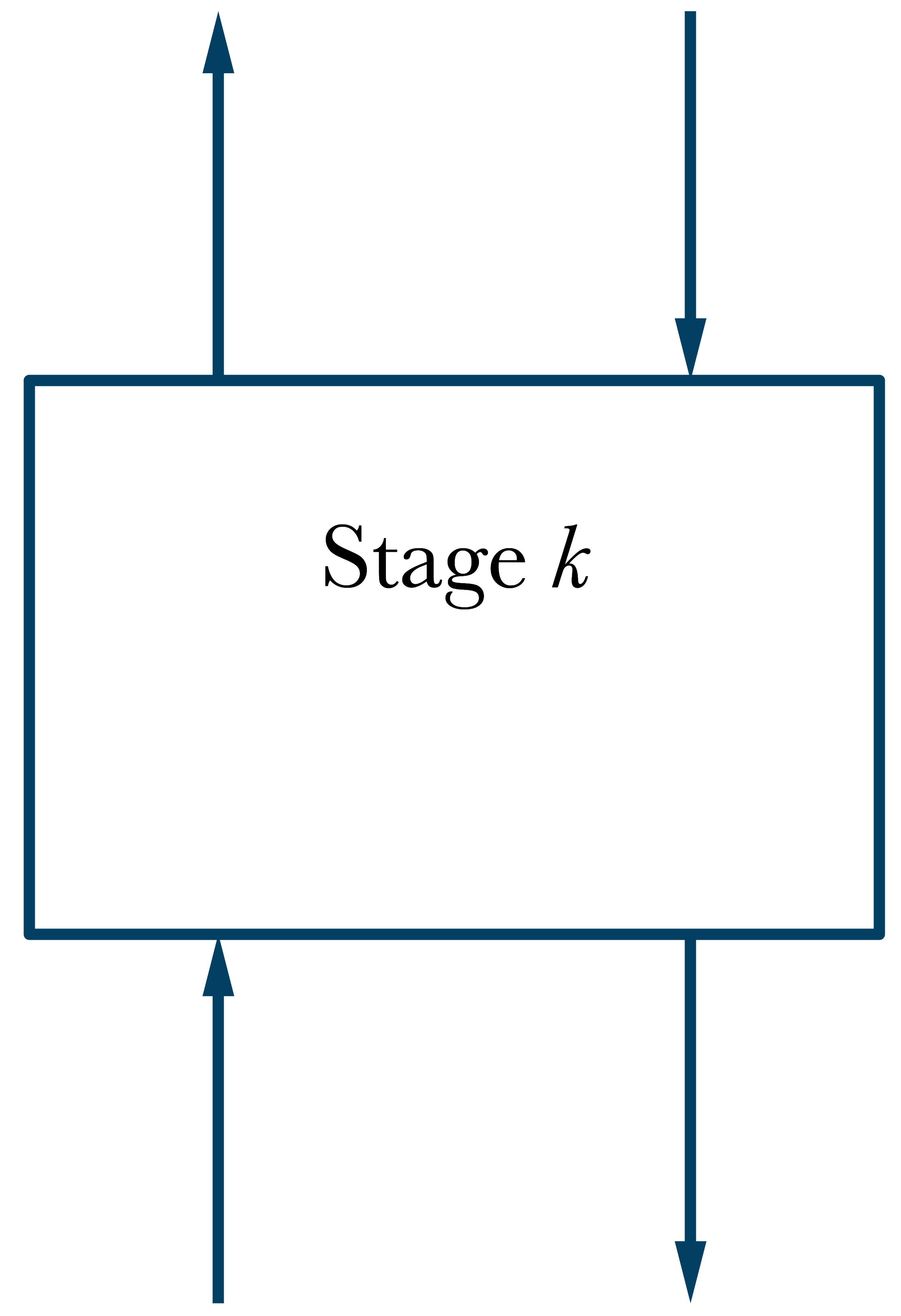
\(\dot{n}_{k-1}^2\)
\(\dot{n}_{k+1}^1\)
\(\dot{n}_{k}^2\)
\(\dot{n}_{k}^1\)
\(T_k,\ P_k\)
Mole Balance in General
\(\dot{n}_{k+1}^1 + \dot{n}_{k-1}^2 = \dot{n}_{k}^1 + \dot{n}_{k}^2 = \dot{n}_\mathrm{tot}\)
\(x_{i,k+1}\dot{n}_{k+1}^1 + y_{i,k-1}\dot{n}_{k-1}^2 = x_{i,k}\dot{n}_{k}^1 + y_{i,k}\dot{n}_{k}^2\)
\(z_{i,k} = \dfrac{{x_{i,k+1}}\dot{n}_{k+1}^1 + {y_{i,k-1}}\dot{n}_{k-1}^2}{(\dot{n}_{k+1}^1 + \dot{n}_{k-1}^2)\text{ or }\dot{n}_\mathrm{tot}} = \dfrac{{x_{i,k}}\dot{n}_{k}^1 + {y_{i,k}}\dot{n}_{k}^2}{(\dot{n}_{k}^1 + \dot{n}_{k}^2)\text{ or }\dot{n}_\mathrm{tot}}\)
\(\dfrac{\dot{n}_{k}^1}{{\dot{n}_\mathrm{tot}}} = \dfrac{\dot{n}_{k}^1}{\dot{n}_{k}^1 + \dot{n}_{k}^2}, \hspace{30mm}\dfrac{\dot{n}_{k}^2}{{\dot{n}_\mathrm{tot}}} = \dfrac{\dot{n}_{k}^2}{\dot{n}_{k}^1 + \dot{n}_{k}^2}\)
Phase Equilibria
Phase Diagrams \(\hspace{30mm}\) All at \(T_k\), \(P_k\)
Raoult’s law \(y_{i,k}P_k = x_{i,k}p_{i,k}^*\)
\(\dot{n}_{k-1}^v\)
\(\dot{n}_{k+1}^l\)
\(\dot{n}_{k}^v\)
\(\dot{n}_{k}^l\)
\(T_k,\ P_k\)
Mole Balance for Distillation
\(\dot{n}_{k+1}^l + \dot{n}_{k-1}^v = \dot{n}_{k}^l + \dot{n}_{k}^v = \dot{n}_\mathrm{tot}\)
\(x_{i,k+1}\dot{n}_{k+1}^l + y_{i,k-1}\dot{n}_{k-1}^v = x_{i,k}\dot{n}_{k}^l + y_{i,k}\dot{n}_{k}^v\)
\(z_{i,k} = \dfrac{{x_{i,k+1}}\dot{n}_{k+1}^l + {y_{i,k-1}}\dot{n}_{k-1}^v}{(\dot{n}_{k+1}^l + \dot{n}_{k-1}^v)\text{ or }\dot{n}_\mathrm{tot}} = \dfrac{{x_{i,k}}\dot{n}_{k}^l + {y_{i,k}}\dot{n}_{k}^v}{(\dot{n}_{k}^l + \dot{n}_{k}^v)\text{ or }\dot{n}_\mathrm{tot}}\)
\(\mathcal{L}_k = \dfrac{\dot{n}_{k}^l}{{\dot{n}_\mathrm{tot}}}, \hspace{30mm} \mathcal{V} = \dfrac{\dot{n}_{k}^v}{{\dot{n}_\mathrm{tot}}}\)
Phase Equilibria
Phase Diagrams \(\hspace{25mm}\) All at \(T_k\), \(P_k\)
Raoult’s law \(y_{i,k}P_k = x_{i,k}p_{i,k}^*\)
\(\dot{n}_{k-1}^v\)
\(\dot{n}_{k+1}^l\)
\(\dot{n}_{k}^v\)
\(\dot{n}_{k}^l\)
\(T_k,\ P_k\)
Types of Calculations
Given \(T_k\) and \(x_{i,k}\), find \(P_k\) and \(y_{i,k}\). BUBL P
Given \(P_k\) and \(x_{i,k}\), find \(T_k\) and \(y_{i.k}\). BUBL T
Given \(T_k\) and \(y_{i,k}\), find \(P_k\) and \(x_{i,k}\). DEW P
Given \(P_k\) and \(y_{i,k}\), find \(T_k\) and \(x_{i,k}\). DEW T
Given \(T_k\), \(P_k\), and \(z_{i,k}\), find \(\mathcal{L}_k\), \(\mathcal{V}_k\),
\(x_{i,k}\), and \(y_{i,k}\).
FLASH
Thanks for watching!
The previous video is in the link in the upper left. The next video in the series, is in the upper right. To learn more about Chemical and Thermal Processes, visit the website linked in the description.