Is It Hot in Here, or Just My Thermistor?
DOFPro Team

Glass Thermometer
| Spec. | Value |
|---|---|
| Range: | lowest \(-100\ ^\circ\mathrm{C}\), highest \(260\ ^\circ\mathrm{C}\) |
| Accuracy: | \(\pm0.2\ ^\circ\mathrm{C}\) to \(\pm4\ ^\circ\mathrm{C}\) |
| Reading: | Visual |
| Size: | \(50\ \mathrm{mm}\) to \(60\ \mathrm{cm}\) |
| \(\tau\): | \(30\ \mathrm{s}\) Typical |
| Contact? | Contact |
| Environ: | Same as for soda-lime glass |
| Uses: | General purpose, Labs |
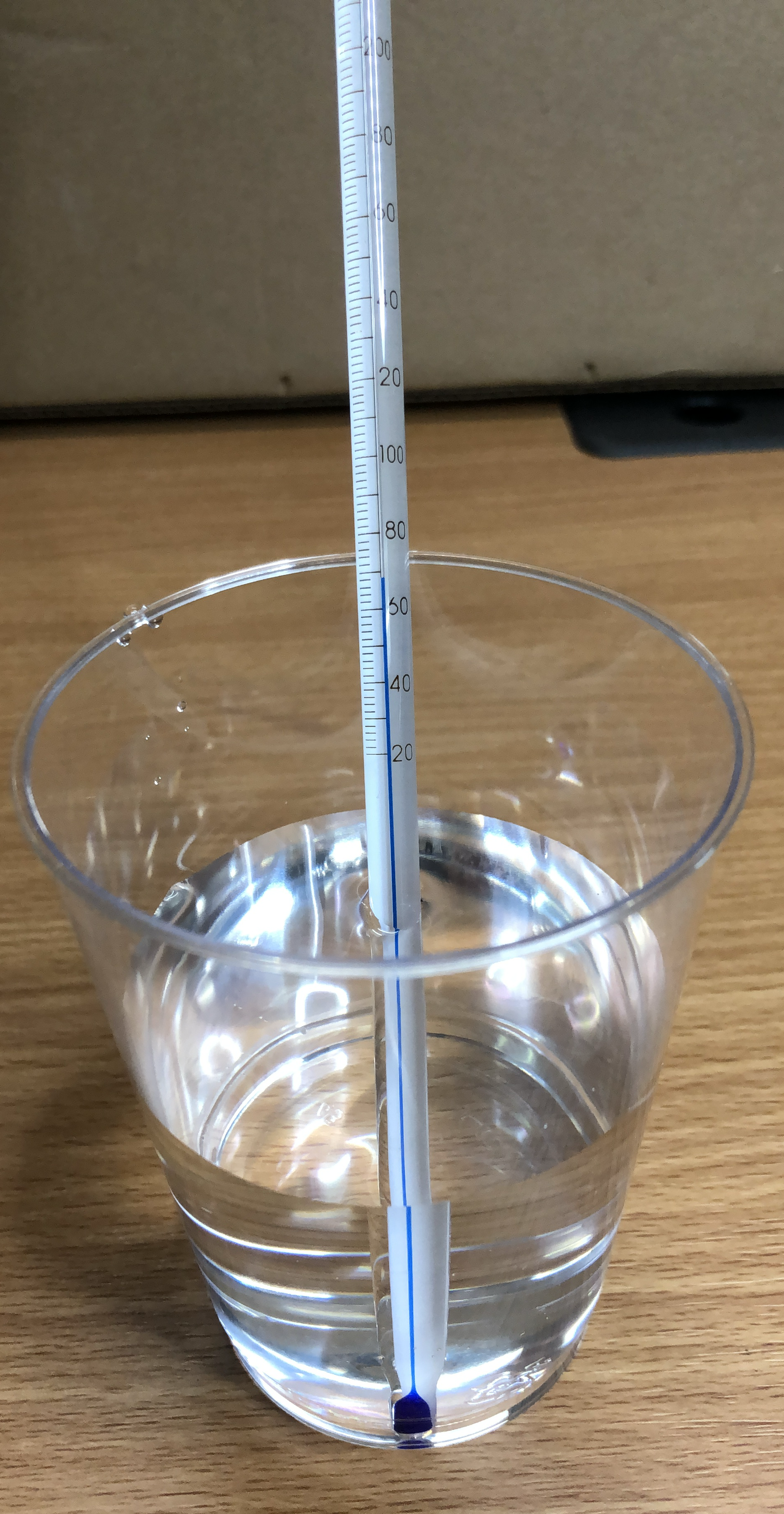
Notes: Glass thermometers are subject to breakage, and if they contain mercury, they present a material hazard. They typically have a specified immersion depth for the most accurate readings.
Dial or Bimetallic Thermometer
| Spec. | Value |
|---|---|
| Range: | lowest \(-80\ ^\circ\mathrm{C}\), highest \(550\ ^\circ\mathrm{C}\) |
| Accuracy: | \(\pm1\%\) to \(\pm3\%\) |
| Reading: | Visual |
| Size: | \(50\ \mathrm{mm}\) to \(60\ \mathrm{cm}\) |
| \(\tau\): | \(20\ \mathrm{s}\) Typical |
| Contact? | Contact |
| Environ: | Same as for stainless steel |
| Uses: | Cooking, Industrial, Labs |
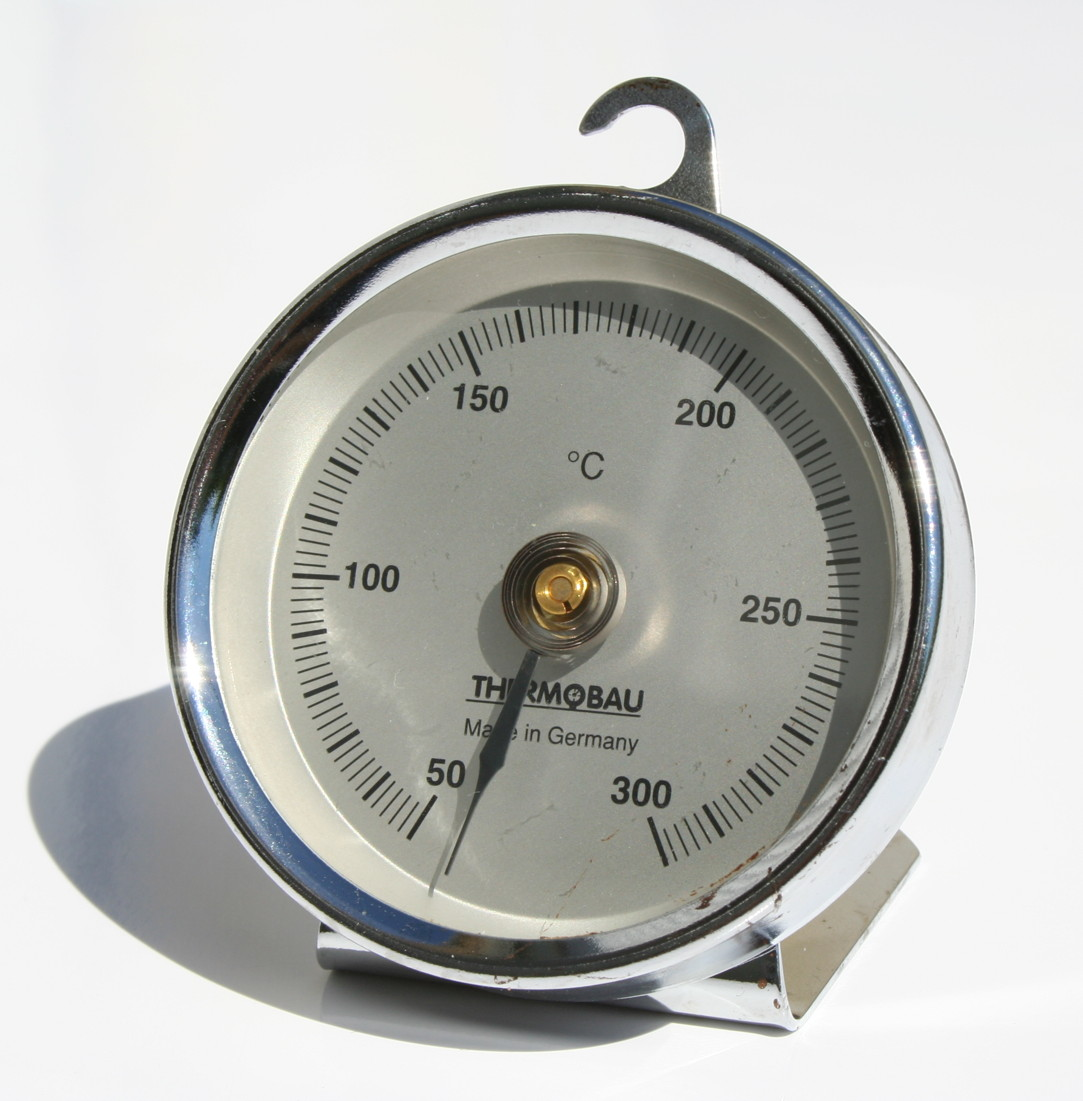
Gmhofmann, CC BY-SA 3.0, via Wikimedia Commons
Notes: Bimetallic or dial thermometers are not for high-precision measurements but are inexpensive and reliable.
Liquid Crystal
| Spec. | Value |
|---|---|
| Range: | lowest \(-30\ ^\circ\mathrm{C}\), highest \(120\ ^\circ\mathrm{C}\) |
| Accuracy: | \(\pm1\ ^\circ\mathrm{C}\) to \(\pm3\ ^\circ\mathrm{C}\) |
| Reading: | Visual |
| Size: | \(15\ \mathrm{mm} \times 45\ \mathrm{mm}\) to \(1.5\ \mathrm{cm} \times 15\ \mathrm{cm}\) |
| \(\tau\): | \(30\ \mathrm{s}\) Typical |
| Contact? | Contact |
| Environ: | Benign environments only. |
| Uses: | Aquariums, Refrigerators, Labs |
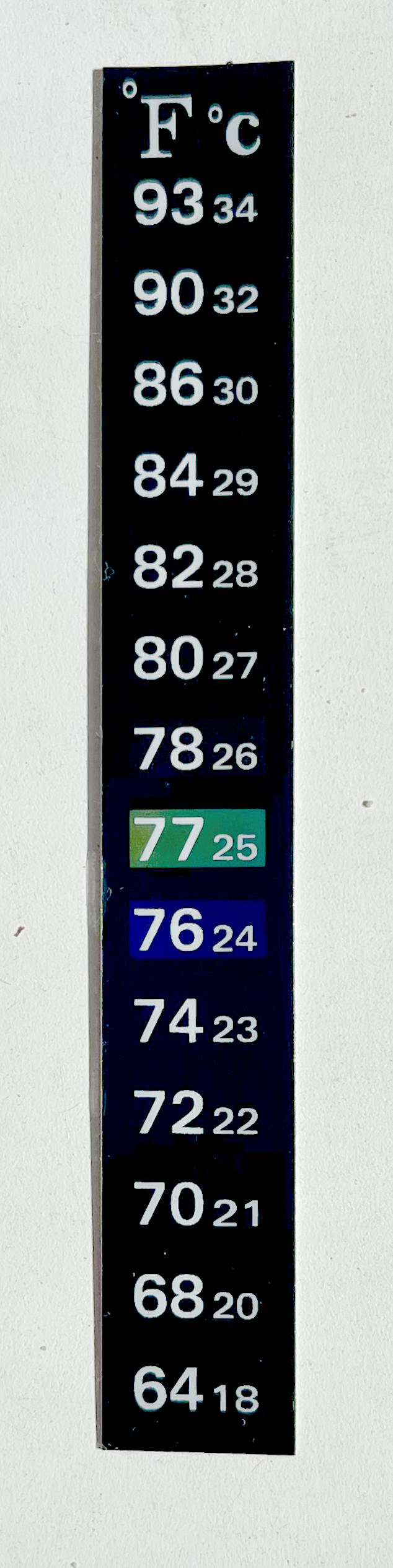
Notes: The displays are easy to read and visually appealing. Liquid Crystal thermometers are not very robust and typically last for 2 to 3 years before needing to be replaced. They are typically quite inexpensive.
Thermistor
| Spec. | Value |
|---|---|
| Range: | lowest \(-100\ ^\circ\mathrm{C}\), highest \(300\ ^\circ\mathrm{C}\) |
| Accuracy: | \(\pm0.01\ ^\circ\mathrm{C}\) to \(\pm5\ ^\circ\mathrm{C}\) |
| Reading: | Electronic (Resistance) |
| Size: | \(0.5\ \mathrm{mm} \times 3\ \mathrm{mm}\) to \(3\ \mathrm{mm} \times 30\ \mathrm{cm}\) |
| \(\tau\): | \(300\ \mathrm{ms}\) to \(30\ \mathrm{s}\) |
| Contact? | Contact |
| Environ: | Keep in temperature range. Sheath determines ruggedness |
| Uses: | Personal electronics, Appliances, Automotive, Industrial, Lab |
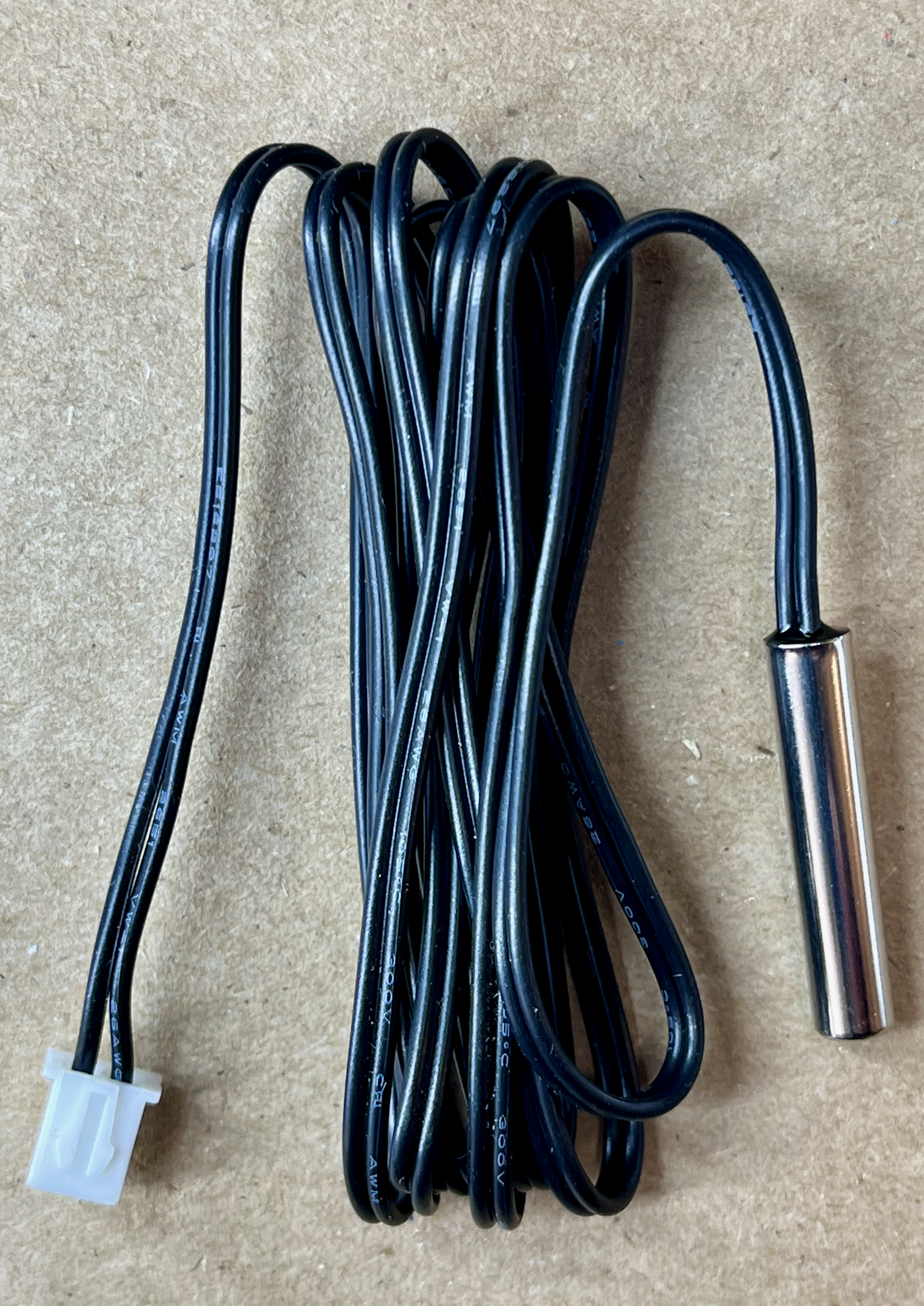
Notes: Within their temperature range, thermistors are usually the best choice for a given accuracy at low cost. They have a large signal range for a small temperature change. They are very nonlinear and the processing circuitry must change the resistance to a voltage for reading.
Thermocouple
| Spec. | Value |
|---|---|
| Range: | lowest \(-270\ ^\circ\mathrm{C}\), highest \(2760\ ^\circ\mathrm{C}\) |
| Accuracy: | \(\pm0.5\ ^\circ\mathrm{C}\) to \(\pm4.5\ ^\circ\mathrm{C}\) |
| Reading: | Electronic (Voltage) |
| Size: | \(0.15\ \mathrm{mm}\) to \(1.5 \ \mathrm{cm} \times 60\ \mathrm{cm}\) |
| \(\tau\): | \(10\ \mathrm{ms}\) to \(30\ \mathrm{s}\) |
| Contact? | Contact |
| Environ: | Ranges from delicate to extremely rugged |
| Uses: | Industrial, Labs |
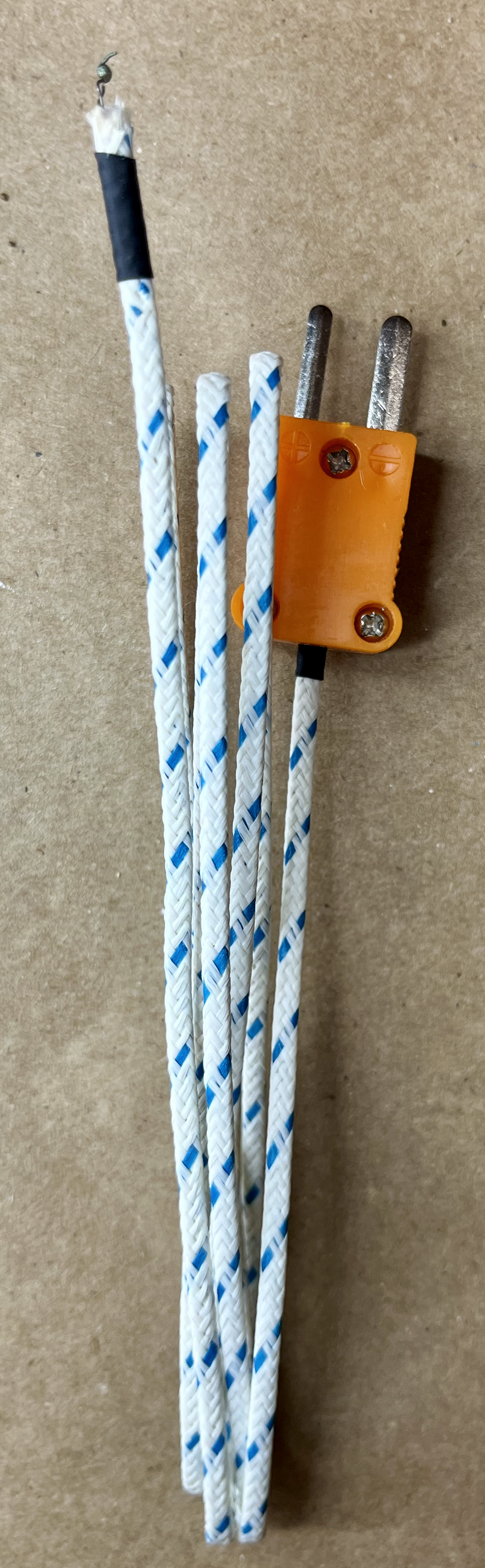
Notes: Thermocouples can be extremely inexpensive, but their accuracy is fairly low. They generate voltages in the millivolt range and need to be compensated for greatest accuracy. They are sensitive to electromagnetic interference and leads normally need to be twisted-pair wires. They find extensive use in industry.
::::
Solid-State Temperature Sensor
| Spec. | Value |
|---|---|
| Range: | lowest \(-55\ ^\circ\mathrm{C}\), highest \(125\ ^\circ\mathrm{C}\) |
| Accuracy: | \(\pm0.25\ ^\circ\mathrm{C}\) to \(\pm2\ ^\circ\mathrm{C}\) |
| Reading: | Electronic (Voltage) or Digital |
| Size: | \(3\ \mathrm{mm}\) to \(10\ \mathrm{mm}\) |
| \(\tau\): | \(30\ \mathrm{s}\) Typical |
| Contact? | Contact |
| Environ: | Typical for semiconductor |
| Uses: | Personal electronics, Appliances, Automotive, Industrial, Lab |
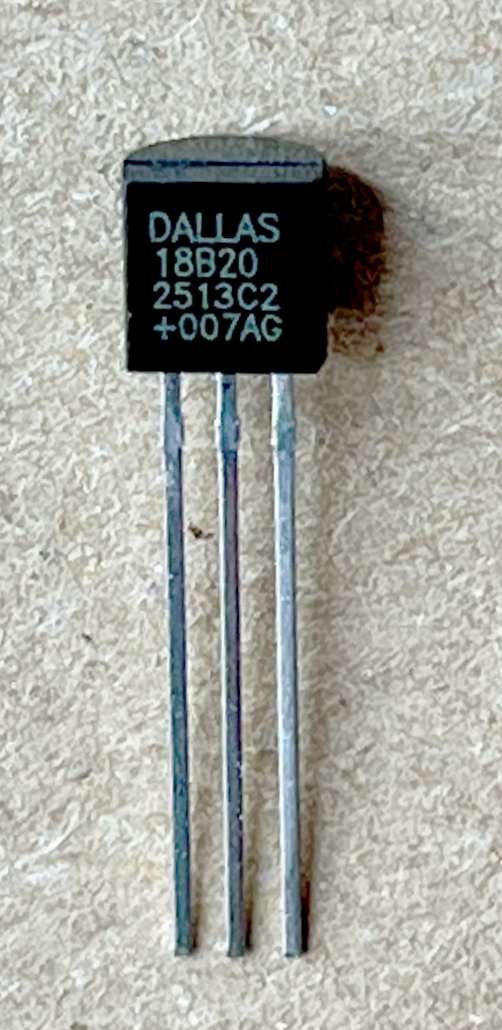
Notes: Solid-state temperature sensors are basically thermistors with additional conditioning circuitry to reduce the engineering effort to integrate them into a device. They typically produce either a voltage such as \(10\ \mathrm{mV/^\circ C}\) or a digital output using an I2C or SPI bus.
Resistance Temperature Detector (RTD)
| Spec. | Value |
|---|---|
| Range: | lowest \(-200\ ^\circ\mathrm{C}\), highest \(850\ ^\circ\mathrm{C}\) |
| Accuracy: | \(\pm0.06\ ^\circ\mathrm{C}\) to \(\pm4.6\ ^\circ\mathrm{C}\) |
| Reading: | Electronic (Resistance) |
| Size: | \(1\ \mathrm{mm}\) to \(60\ \mathrm{cm}\) |
| \(\tau\): | \(0.5\ \mathrm{s}\) to \(30\ \mathrm{s}\) |
| Contact? | Contact |
| Environ: | Depends on packaging. Can be very rugged. |
| Uses: | Labs, Precision Industrial |
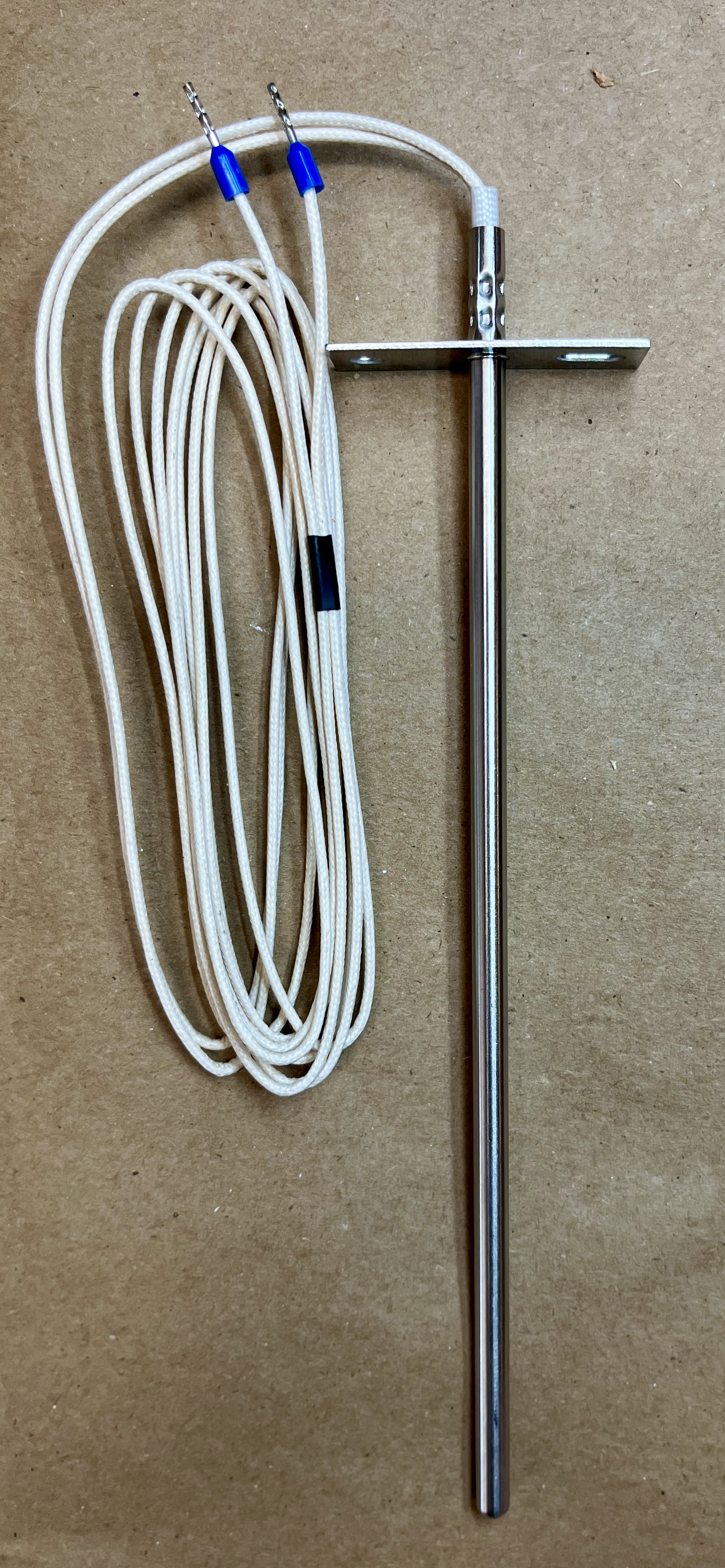
Notes: Resistance temperature devices can be very accurate and very stable. They’re typically made from precision-formulated platinum wire and have a nominal resistance of \(100\ \Omega\) or \(1000\ \Omega\). The processing circuitry is rather involved, but the accuracy and stability with time make them a favorite in lab settings.
Optical or Infrared Pyrometer
| Spec. | Value |
|---|---|
| Range: | lowest \(-50\ ^\circ\mathrm{C}\), highest \(>2000\ ^\circ\mathrm{C}\) |
| Accuracy: | \(\pm0.5\ ^\circ\mathrm{C}\) to \(>\pm20\ ^\circ\mathrm{C}\) |
| Reading: | Visual, sensor is electronic |
| Size: | Usually handheld |
| \(\tau\): | \(\text{sub-ms}\) to \(10\ \mathrm{s}\) |
| Contact? | Non-Contact |
| Environ: | Avoid harsh conditions |
| Uses: | Home, Industry, Labs |
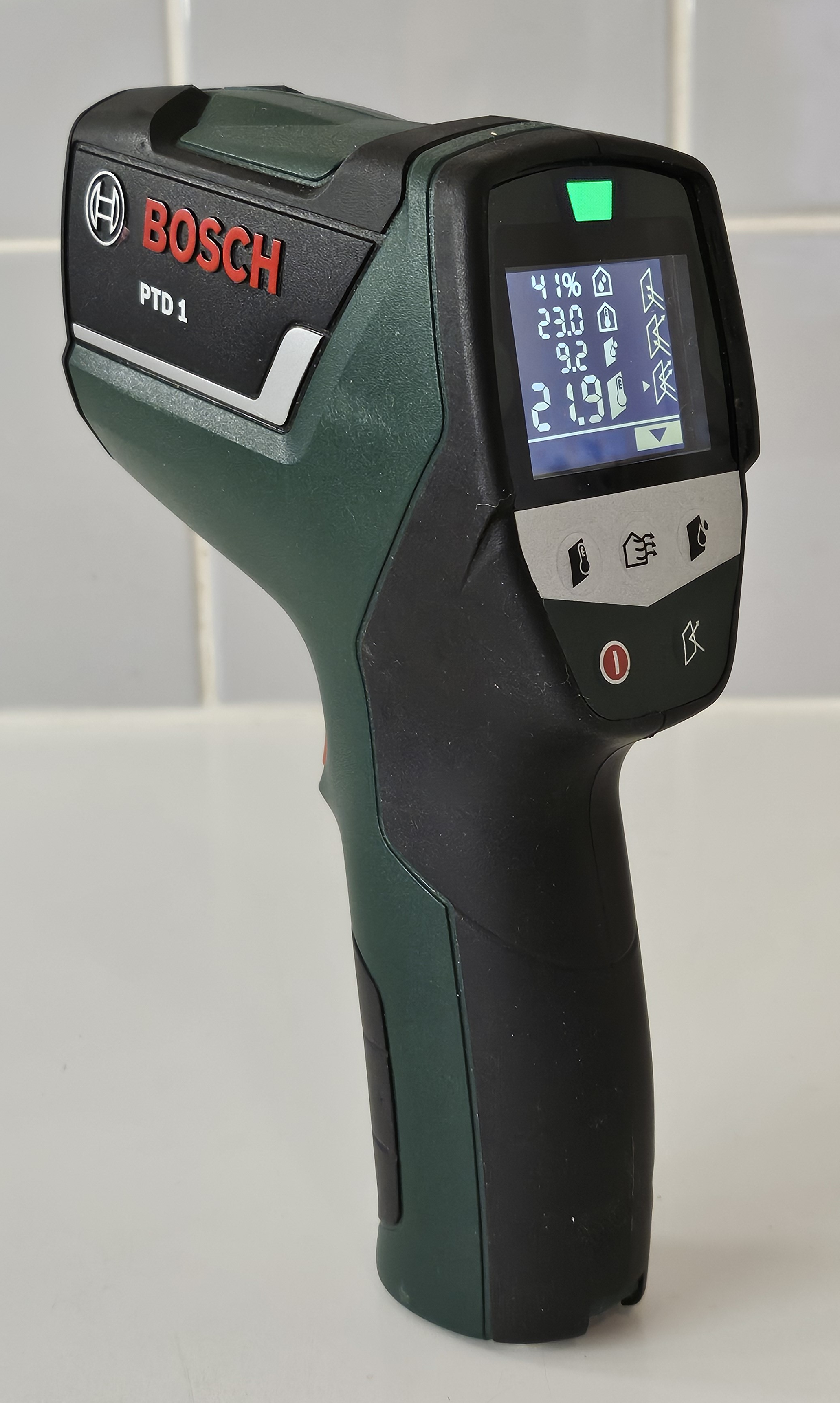
Janim71, CC0, via Wikimedia Commons
Notes: Optical and Infrared Pyrometers all use some form of Planck’s law to calculate temperature by measuring emitted thermal radiation. They all have to make some assumptions about the surface they are pointed at and stray light. When they work, they work very well. When they don’t, they can have large undetected errors.
Thanks for watching!
The previous video in the series is in the link in the upper left. The next video in the series is in the upper right. To learn more about Chemical and Thermal Processes, visit the website linked in the description.
The DOFPro Team