Intro and Topics
- Video links go directly to the YouTube video.
- JTF (Just the Facts) videos are the streamlined versions: greenscreen LaTeX equations, clean graphics, minimal narrative. Think efficient and to the point. Each has a companion TFS video.
- TFS (The Full Story) videos include interviews, additional explanation, and equations written on whiteboards. Same math, more context, more personality. Each has a matching JTF version.
- Info Page links lead to definitions, expanded explanations, and related material—because sometimes you really do need to explain it.
- Visuals links contain the greenscreen or whiteboard materials used in the video, for those who like to see the scaffolding.
- Wondering about the titles? See Appendix B: If you have to explain it, it’s no longer funny.
- Videos marked This is NOT a DOFPro video were not produced by DOFPro but are included because they are relevant to the topic. They are shown in red so no one calls the academic integrity police.
Introduction
DOFPro CTP is a guided collection of videos, visuals, and reference pages covering the core topics of chemical and thermal process engineering. The site is organized so that you can either move through the material topic by topic or follow one of several curated pathways depending on your background and goals.
The introductory video below gives a broad overview of the subjects covered in the project, from basic process variables and engineering calculations all the way through balances, thermodynamics, reactors, phase equilibria, and process cycles.
From Mole to Megawatt:
The Full Journey Through
Chemical and Thermal Engineering
This video introduces the scope of the DOFPro CTP project and gives a high-level tour of the topics covered throughout the site.
List of Topics
The videos and reference pages on this site are organized around the major tools and ideas used in chemical and thermal engineering.
Introduction
The introduction provides a broad overview of the discipline and shows how the major topics connect to one another.
Basic Engineering Calculations
The first group of videos covers the calculation tools that engineers use repeatedly in later topics.
Transformation and presentation of process data
How to visualize data, recognize trends, and choose useful coordinate systems.
Interpolation, both linear and nonlinear
How to estimate values from tabulated data when an exact tabulated value is not available.
Spreadsheets for calculations, statistics, and regression
How to use spreadsheets as practical engineering tools for calculations, fitting, and numerical work.
Roots of linear and nonlinear equations
How to solve engineering equations that cannot be rearranged directly into closed form.
Statistics and Measurements
How to describe uncertainty, summarize data, and extract useful information from experimental results.
Unit, Temperature, and Equation Conversions
How to work with engineering units, temperature scales, dimensional equations, and equations with units.
Types of process data
How engineers define and use common process variables such as pressure, temperature, flow rate, density, moles, and composition.
Balances
The balances section develops the general balance equation and applies it to material, energy, entropy, and exergy.
Phase Equilibria
This section introduces phase diagrams, dew and bubble calculations, flash calculations, and staged separations.
Reactors
This section covers material balances around reacting systems, including conversion-based, kinetic, and equilibrium reactor models.
Appendices
The appendices collect supporting material, including explanations of titles, pathways, and other reference information.
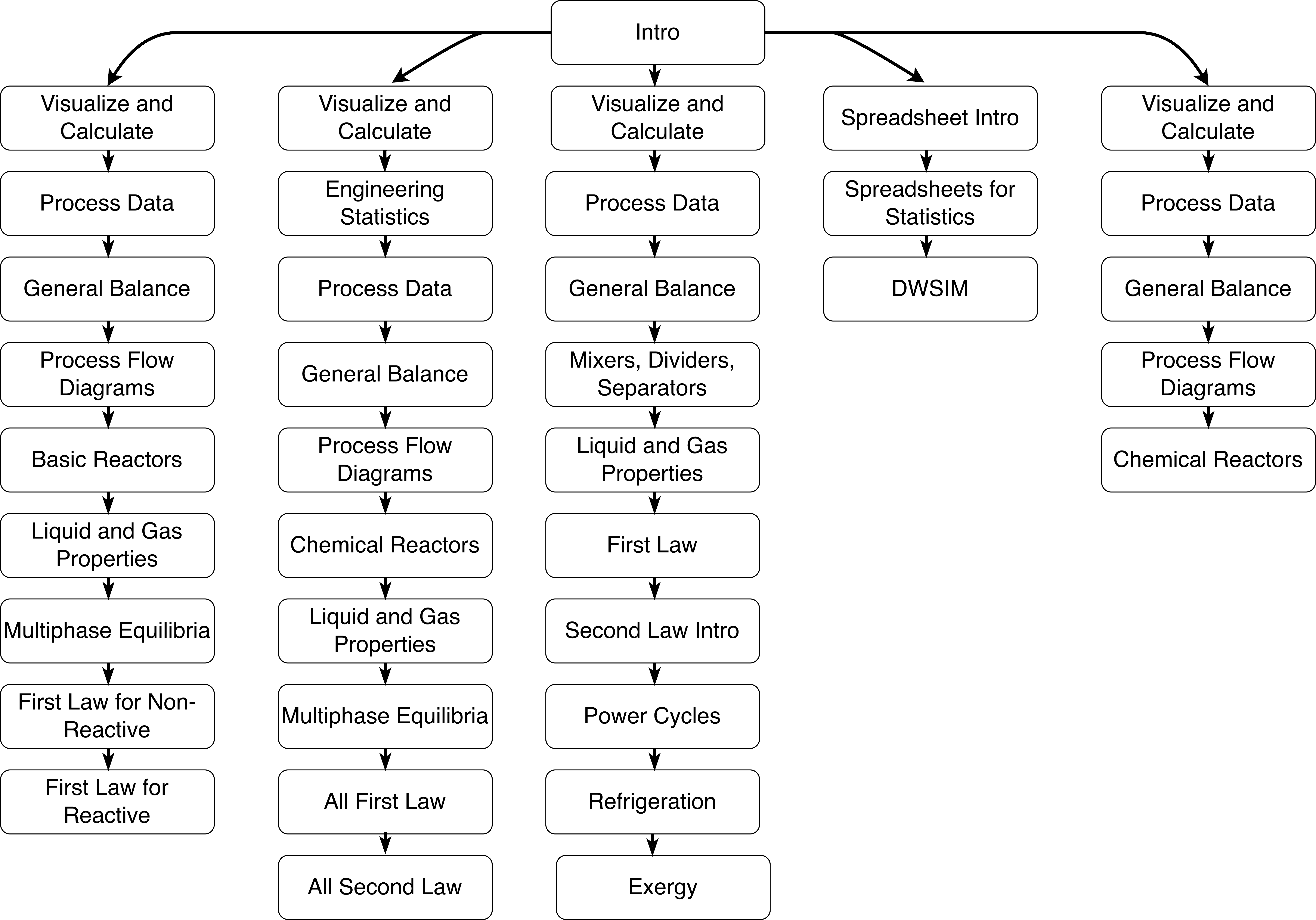
Pathways Through the Videos
You can move through the videos in several different ways. The pathway pages below collect videos into useful sequences for different audiences and purposes.
| Intro to Chemical Engineering | The Full Video Set | Mechanical Engineering Thermodynamics | Spreadsheets | Chemical Reactor Engineering |
|---|
The diagram below shows these pathways visually.